Last Updated on October 23, 2026 by Pokie Player
Key Points
- A changed pokie site URL can indicate a mirror domain, permanent migration, technical change or phishing clone. The new address alone does not reveal which.
- ACMA blocking restricts access to identified websites; it does not necessarily shut down the operator’s infrastructure. Replacement domains can appear.
- Authenticity is not authorisation. Even a genuine operator-controlled mirror does not make offshore online pokies authorised in Australia.
- Familiar logos, working support chats and “official mirror” labels do not prove ownership. Absence from ACMA’s blocked list is not approval.
- Check unexpected migration claims through independently established contact details and authoritative records. Never deposit money to test a link or pay an unexplained fee to unlock an existing balance.
- If you shared sensitive information, secure exposed accounts, contact your financial provider where relevant and preserve evidence. Use official reporting channels, but do not assume a report guarantees recovery.
Pokie Site URL Changed? Understand Mirrors, ACMA Blocks and Phishing Risks
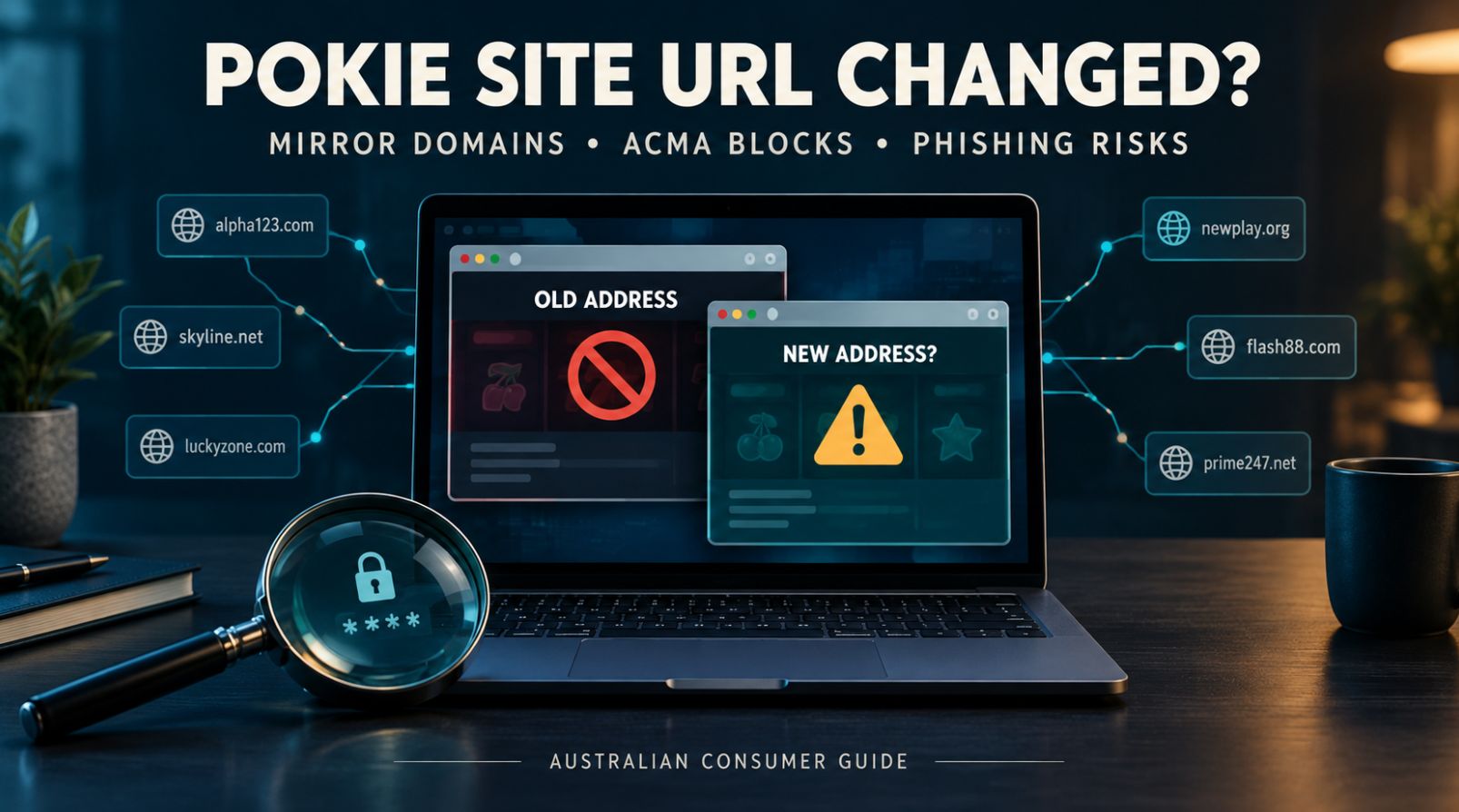
Your bookmark stops working. A message says your usual pokie site has moved. The replacement has the same logo, game thumbnails and support button—but a different web address.
Should you trust it?
Not on appearance alone.
A changed URL can reflect an operator-controlled mirror, a permanent migration, a technical problem or an unrelated impersonation. Without evidence about the particular website, nobody can reliably tell you which explanation applies.
For Australians, ACMA blocking is another important possibility. The Australian Communications and Media Authority asks internet service providers to block websites offering prohibited gambling services, unlicensed wagering or related advertising.
However, an access block does not necessarily remove the operator’s infrastructure. A replacement domain can appear while the underlying service continues elsewhere.
That creates two separate questions: does the original operator control the new address, and is the service authorised to serve Australians?
Those questions must not be confused. A genuine mirror of an offshore casino does not become authorised simply because it belongs to the same business.
This guide explains URL changes, DNS blocking and the checks that can reduce phishing exposure. It does not provide alternative gambling links or instructions for bypassing restrictions. No checklist can certify an offshore mirror as safe.
First, Establish What Actually Changed
“URL changed” can describe several different events.
A URL is the complete address shown in your browser. Its components can include the website’s domain, a page path and additional information.
Changing a page within a website is different from moving to another domain.
A language preference, account page or tracking parameter can alter the complete address without changing the organisation controlling the site. A new domain raises a more substantial ownership question.
| What you notice | Possible explanation | What it does not prove |
|---|---|---|
| A different page after login | Normal navigation | That every page is trustworthy |
| Another language or regional page | Site configuration | Australian authorisation |
| An unfamiliar domain | Migration, mirror or impersonation | Continuity of ownership |
| An ACMA blocking notice | Access disruption | That your balance has been confiscated |
| A message announcing a move | Genuine notice or phishing | Authenticity of the destination |
| A browser error | Several technical possibilities | ACMA action by itself |
Do not turn an observation into a conclusion before checking the evidence.
Five Reasons a Pokie Site Address Might Change
1. An Operator Introduces a Mirror
An operator-controlled mirror provides an alternative address for its service.
It may connect to existing systems, but account continuity should not be assumed. The label “mirror” does not prove that balances, verification records or withdrawal requests remain intact.
2. The Business Migrates Domains
A migration can involve replacing an old address.
That does not automatically establish unchanged ownership, contractual terms or payment instructions. Those details still need confirmation.
3. Access Has Been Blocked
An operator may publish another address after an ISP restricts access to a previous domain.
The replacement does not reverse the underlying Australian legal issue.
4. A Technical Change Affects Navigation
Maintenance, redirects or website configuration can alter how visitors reach a page.
A temporary error alone cannot identify the cause.
5. Someone Is Impersonating the Brand
A clone can reproduce familiar branding while collecting passwords, payments or identification documents.
A convincing explanation for the change is not proof that the explanation is true.
What ACMA Blocking Actually Does
ACMA explains that it can ask ISPs to disrupt access to illegal online content under section 313 of the Telecommunications Act 1997.
The Interactive Gambling Act 2001 supplies relevant gambling prohibitions. The telecommunications legislation provides the assistance mechanism used for blocking.
ACMA identifies three examples of grounds for action:
-
Prohibited services, including online casinos and online pokies.
-
Regulated wagering services without a valid Australian licence.
-
Advertising for prohibited or unlicensed services.
That means the blocked list can include gambling websites and affiliate advertising pages.
A block restricts access. It does not necessarily seize the domain, delete the website’s files or return customer money.
An operator can therefore retain infrastructure after one address becomes inaccessible.
The existence of a replacement is not evidence that ACMA approved it or that the original enforcement concern disappeared.
DNS Blocking, Explained Without the Technical Jargon
The Domain Name System, or DNS, helps connect a readable website name with its internet destination.
A useful analogy is an address directory: you enter a name, and the system helps locate the destination.
DNS-based blocking interferes with that lookup for a specified domain. Other blocking arrangements can target particular website addresses.
Government guidance recognises that ISPs can use different methods. It is therefore too broad to claim every failed connection is the same type of DNS block.
The practical limitation is that restricting a name does not necessarily remove the systems behind it.
An alternative domain may be a separate address requiring further assessment and disruption.
This explains the persistence of mirrors. It is not a reason to change network settings, install software or follow bypass instructions.
An access warning should prompt a review of the service—not a search for another entrance.
An Accessible Website Is Not an Approved Website
A page loading successfully establishes only that you reached it.
It does not establish licensing, payment reliability or consumer protection.
Similarly, absence from ACMA’s blocked list is not an approval. A new address may not have been assessed.
ACMA warns that illegal operators may accept deposits while preventing customers from accessing winnings. It also describes operators closing or moving services and customers’ money disappearing.
For Australians, an overseas licence does not authorise a provider to offer online casino games here.
Australian-dollar balances, local imagery and familiar payment options do not change that distinction.
A comparison page calling an address “working”, “verified” or “official” is making a claim. It is not supplying regulatory permission.
The relevant standard is verification, not simple accessibility.
Mirrors and Phishing Clones Are Not Interchangeable
A mirror controlled by the original operator and a phishing clone controlled by an impersonator involve different problems.
The mirror can preserve the original business relationship while retaining the risks of an illegal offshore service.
The clone introduces uncertainty about who receives your information and money.
Australian cyber-security guidance explains that phishing messages can closely resemble genuine communications. They may use familiar logos and convincing wording to obtain passwords, banking details or account access.
Domain changes supply a plausible story: “Your account has moved; sign in here.”
Someone concerned about a pending withdrawal may feel pressure to comply quickly.
That pressure is precisely why independent checking matters.
There is no reliable percentage in this guide for how many mirrors are fraudulent. The warning concerns an identifiable opportunity for impersonation, not an invented prevalence statistic.
Brand Impersonation Is a Documented Risk
In June 2026, ACMA identified websites imitating the licensed ChromaBet and PointsBet wagering services in a blocking announcement.
Those examples demonstrate why a familiar brand name cannot authenticate a domain.
They do not establish that every imitation uses the same phishing method. Nor should licensed wagering be confused with prohibited online casino services.
The lesson is narrower and more useful: a licence associated with a recognised business does not automatically cover another page using similar branding.
Check the exact service and domain against relevant authoritative information.
If the claimed relationship cannot be established, do not treat resemblance as a substitute.
How to Check a Claimed Alternative Link
These steps can reduce exposure to impersonation. They cannot make an offshore casino authorised or guarantee recovery of funds.
Step 1: Pause Before Entering Anything
Do not provide credentials, payment information or identification simply to investigate.
Avoid unexpected downloads, QR codes and browser extensions. A request to install a “new access tool” deserves particular caution.
Step 2: Identify Where the Claim Came From
An unsolicited message, search advertisement, social-media post or affiliate page is not independent proof.
A support chat inside the disputed website cannot independently authenticate that same website.
Record the source of the claim without accepting it.
Step 3: Use Previously Established Contact Details
For an existing account dispute, consult correspondence and records retained before the unexpected change.
The Cyber Security Centre recommends checking requests through trusted sources rather than links supplied in suspicious messages.
Even then, an operator confirming ownership resolves only the ownership question.
Step 4: Check Regulatory Claims Independently
Consult the relevant authority directly. Do not rely solely on a copied licence badge or a page reached through the disputed site.
For Australian offshore pokies, foreign authorisation does not resolve the prohibition on offering those services here.
Step 5: Stop if the Evidence Remains Incomplete
Uncertainty is a reason to withhold information.
Do not make a small deposit as an authenticity test. A payment reaching a recipient does not establish who controls the website or whether withdrawals will follow.
What Familiar “Trust Signals” Cannot Establish
Several reassuring details can be misunderstood.
A Matching Logo
A logo can be copied. It does not identify the person receiving a submitted form.
Professional Language
Phishing can be polished. Poor grammar is a possible warning sign, not a requirement for fraud.
A Working Support Chat
A responsive chat establishes that someone is answering. It does not independently establish their identity.
A Familiar-Looking Balance
A number on a page is not independent proof of available funds or the operator’s ability to pay.
A Friend’s Successful Login
Another person’s experience cannot establish that your session, payment or document submission is safe.
An “Official Mirror” Label
That is a self-description unless supported by independent evidence.
No combination of cosmetic signals creates Australian authorisation for an offshore casino.
Why Urgency Should Change Your Response
The Cyber Security Centre lists pressure to act quickly, requests for authentication codes and unexpected links among phishing warning signs.
A migration message may claim that access will expire or that money will be lost unless you respond.
Do not let the deadline decide the trust question.
A useful response is to preserve the message, stop interacting and check through an independently established channel.
Never give a supposed support agent your password or authentication code.
Do not approve an unexpected login prompt. Do not allow remote access to your device because someone says it will restore your balance.
The more consequential the request, the stronger the need for independent confirmation.
What Happens to Balances and Pending Withdrawals?
A changed address alone cannot answer that question.
Ask separately whether:
-
The same legal entity remains responsible.
-
Your account records still exist.
-
A withdrawal has been approved or merely requested.
-
Payment has actually been initiated.
-
The amount or conditions have changed.
-
Further information is genuinely required.
ACMA warns that blocking can prevent customers from logging in to an existing account.
That does not mean ACMA holds the balance.
The operator’s handling of funds and the ISP’s access restriction are different events.
Do not make another deposit to “synchronise” an account or pay an unexplained fee to recover existing money.
Keep earlier statements, withdrawal confirmations and messages. Those records are more useful than repeatedly checking an unfamiliar page.
If You Entered Your Password on the New Page
Treat possible credential exposure seriously without assuming every unfamiliar page has compromised your device.
From a trusted device, change the exposed password.
If you reused it elsewhere, change those passwords too. Prioritise email and financial accounts because access there can affect other services.
Use strong, unique passwords and enable suitable multi-factor authentication or passkeys where available.
Watch for unfamiliar account activity and unexpected password-reset messages.
If you installed software or allowed remote access, follow official recovery guidance rather than assuming a password change resolves everything.
Stop contact with the suspected scammer.
Do not pay someone who unexpectedly offers guaranteed account recovery.
If You Shared Banking Details or Identification
Contact your financial institution promptly through its official channel if payment information was exposed.
Explain accurately what happened, what information was supplied and which transactions you authorised.
Do not misdescribe a contractual withdrawal dispute as an unauthorised payment.
Identification exposure requires separate attention. Changing a password does not remove a licence image or passport copy already supplied.
The Cyber Security Centre recommends securing accounts, monitoring financial activity and seeking appropriate assistance after identity theft.
Preserve:
-
The page address.
-
Messages and sender details.
-
Transaction receipts.
-
Approximate submission times.
-
A description of documents supplied.
Avoid revisiting a suspected page to gather evidence if that requires further disclosure or downloads.
Reporting and Recovery Options in Australia
Different problems belong with different organisations.
ACMA accepts reports about suspected illegal gambling services. Its reporting process is not a guaranteed refund mechanism.
ReportCyber is an official channel for reporting cybercrime. Scamwatch also receives scam reports.
Your bank or payment provider should hear promptly about exposed payment details or suspicious transactions.
For money withheld by an overseas gambling website, ACMA identifies options including independent legal advice and contacting the relevant licensing authority.
Those routes have limitations. ACMA warns that customers of illegal services may lack important protections.
Keep records and request a written decision about any disputed balance.
A report can assist investigation without resolving an individual claim.
Final Verdict: Verify the Claim, Not Just the Page
A changed pokie URL can have several explanations. ACMA blocking is one possibility, but a browser error or migration message does not prove the cause.
Mirrors can preserve an operator’s service. Clones can imitate it. Neither familiar artwork nor successful access establishes safety.
For Australians, authentic ownership and legal authorisation remain separate questions. Confirming that an offshore operator controls an address does not make online pokies authorised here.
Do not follow unfamiliar migration links, disclose documents or send payments to test authenticity.
Use independently established contact information, consult authoritative records and preserve evidence about existing balances.
If ownership or instructions remain uncertain, stop. The safest result of checking a link may be deciding not to use it.
Frequently Asked Questions
Why has my usual pokie site changed its URL?
A new address can reflect an operator-controlled mirror, a permanent domain migration, a technical change or an impersonation attempt. ACMA blocking may also prompt an operator to introduce another domain. A changed URL or browser error alone does not establish what happened.
Does ACMA blocking shut down the entire casino website?
Not necessarily. An ISP block restricts access to an identified address; it does not automatically remove the operator’s hosting infrastructure or account systems. Another domain may appear, but that replacement does not make the service authorised in Australia.
How can I check whether a claimed alternative link belongs to the original operator?
Do not enter passwords, upload documents or deposit money while investigating. Check the migration claim through independently established contact details retained from earlier records, and verify regulatory claims directly with the relevant authority. Familiar branding and a support chat on the disputed page are not independent proof. Even confirmed ownership does not guarantee safety or Australian authorisation.
Is a pokie site safe if it is not on ACMA’s blocked list?
No. Absence from the list does not mean the website has been assessed, approved or verified. A new domain may not yet have been investigated. Overseas licensing, Australian-dollar balances and familiar payment logos also do not establish permission to offer online pokies to Australians.
What should I do if I entered personal details on a suspected clone?
Prioritise security. From a trusted device, change exposed and reused passwords, secure your email and enable suitable multi-factor authentication. Contact your financial provider promptly if payment details were shared. Preserve messages and transaction records, seek appropriate help for identification-document exposure and report the incident through official channels. Do not pay anyone promising guaranteed recovery.
Sources
- ACMA: Website blocking authority, prohibited services and the limits of the blocked-site list.
- ACMA: Section 313 website-disruption requests and ongoing monitoring.
- Australian Government: Guidelines for lawful disruption of access to online services.
- Clayton Utz: Different ISP blocking methods and targeted domain or URL restrictions.
- ACMA: Offshore gambling risks, blocked account access and recovery options.
- ACMA: Documented examples of websites imitating licensed wagering brands.
- Australian Cyber Security Centre: Phishing warning signs and independently checking requests.
- Australian Cyber Security Centre: Securing accounts and contacting financial institutions after a scam.
- Australian Cyber Security Centre: Identity exposure, account protection and reporting.
- Australian Cyber Security Centre: Official cybercrime reporting channels.