Last Updated on October 23, 2026 by Pokie Player
Key Points
- RTP and volatility measure different things. RTP describes a game’s theoretical long-run return; volatility describes how widely outcomes vary around that average.
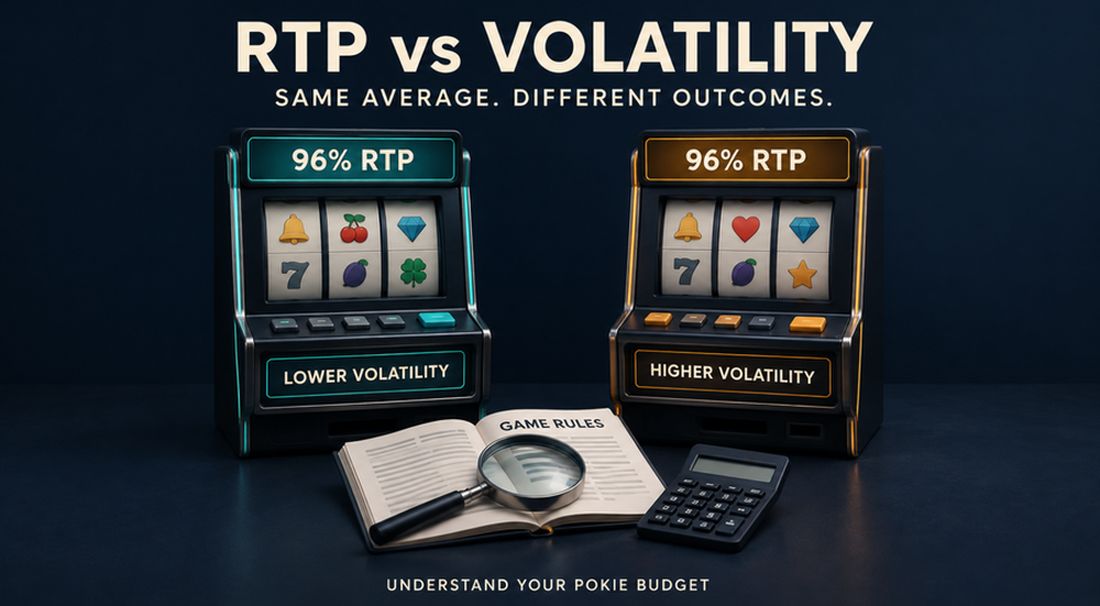
- Two 96% RTP pokies can behave differently. A lower-volatility game generally returns smaller amounts more frequently, while a higher-volatility game concentrates more return in rarer, larger prizes.
- A 96% RTP does not promise A$96 back from an A$100 deposit. It relates to cumulative stakes over extensive play—not your individual session.
- Stake size matters. Larger bets expose more of your available budget on each spin, regardless of the volatility label.
- Frequent payouts do not necessarily mean profit. Receiving less than you staked is still a net loss, even when the machine celebrates.
- Previous losses do not make an ordinary independent spin more likely to win. Never increase spending because a feature feels “due”.
- Set an affordable spending and time limit first. Neither high RTP nor low volatility guarantees that your balance will last.
Why Two 96% RTP Pokies Can Deliver Very Different Sessions
Two pokies can both advertise a 96% return to player and deliver completely different sessions.
One might return smaller amounts relatively often. The other might produce long stretches without a meaningful payout, with more of its theoretical return concentrated in rare, larger prizes.
Neither game is necessarily malfunctioning. The difference is largely explained by volatility.
RTP describes the average return built into a game’s mathematics. Volatility describes the spread of possible outcomes around that average. Your stake, available spending money and number of spins determine how those characteristics affect a session.
Understanding the distinction will not turn pokies into a reliable way to make money. It can, however, help you recognise why a high RTP does not protect a small balance and why frequent celebrations do not necessarily mean you are ahead.
This guide uses hypothetical examples rather than recommending particular machines. The 96% figure is illustrative, not a claim that every Australian venue offers games at that percentage.
The starting point is simple: choose a spending limit before considering a game. RTP and volatility describe gambling products; neither should decide how much money you can afford to lose.
RTP and Volatility: The Difference at a Glance
| Measure | What it describes | What it does not tell you |
|---|---|---|
| RTP | The theoretical average proportion of stakes returned as prizes | What your next session will return |
| House edge | The theoretical average proportion retained by the game | Your exact loss on a particular visit |
| Volatility | How widely outcomes vary around the average | When a large prize will arrive |
| Hit frequency | How often a specified type of paying outcome occurs | Whether those payments exceed your stakes |
| Maximum win | The largest possible award under stated rules | How likely you are to receive it |
These concepts answer different questions.
A useful comparison needs more than one number. Even then, it cannot predict an individual session.
What Does 96% RTP Actually Mean?
Return to player, usually shortened to RTP, is a theoretical measure derived from a game’s prize structure and probabilities.
A game with 96% RTP is designed to return an average of A$96 in prizes for every A$100 staked over a sufficiently large volume of play.
That does not mean an A$100 deposit becomes A$96.
It also does not mean every player receives the same percentage.
You could finish ahead, lose the entire amount or stop with something in between.
RTP Relates to Turnover, Not Just Your Starting Money
Turnover is the total amount staked.
If you start with A$50, receive some payouts and repeatedly stake those funds, your turnover can exceed A$50.
For a hypothetical 96% game, A$500 of fixed qualifying turnover corresponds to an expected net loss of A$20.
That is a mathematical average, not a bill or guaranteed outcome.
Do not keep playing to “reach” the advertised return. There is no point at which the game owes you a personal adjustment.
House Edge: The Other Side of RTP
For a straightforward game, house edge is:
A 96% RTP therefore corresponds to a 4% theoretical house edge.
At the same turnover, a higher RTP means a lower expected loss, assuming the quoted figures apply to the actual game and conditions being compared.
That is a meaningful distinction, but it needs context.
A lower edge does not eliminate short-term losses. It also does not compensate for dramatically increasing your stake or playing longer.
A person wagering more money on a higher-RTP game can have a greater expected monetary loss than someone making fewer, smaller wagers on a lower-RTP game.
The relevant comparison includes both the percentage and the amount put through the game.
What Is Pokie Volatility?
Volatility describes how dispersed a game’s outcomes are.
In practical reviews, games are often labelled low, medium or high volatility. These labels summarise the payout profile rather than specifying your next result.
Lower Volatility
Lower-volatility games generally distribute more return through smaller, more frequent payments.
That can produce a less uneven-looking session.
However, frequent payments may still be smaller than the stake. A balance can decline steadily while the machine repeatedly celebrates.
Higher Volatility
Higher-volatility games concentrate more return in relatively large, less frequent outcomes.
A session may include extended periods of limited return. Occasionally, a larger prize can substantially change the balance.
The large outcome is possible, not promised.
Medium Volatility
A medium label suggests an intermediate profile, but there is no universal consumer scale that makes every manufacturer’s rating directly interchangeable.
Treat descriptions as useful context, not precise cross-brand measurements.
Variance and Volatility: Are They the Same?
Casino reviews often use the terms interchangeably.
Mathematically, variance measures the average squared distance of outcomes from their mean. Standard deviation is the square root of variance.
Volatility is commonly used more broadly to describe the resulting spread and session behaviour.
Most players are not given a complete probability table or a numerical variance calculation.
Consequently, a “high variance” label usually communicates a general payout pattern rather than enough information to calculate the likelihood of exhausting a particular balance.
Do not attach false precision to a simple label.
Without the game’s full distribution and your exact playing conditions, you cannot reliably calculate your chances of lasting a specified number of spins.
Why Two 96% Games Can Feel Completely Different
Consider two deliberately simplified games. Each costs A$1 per play.
These are mathematical illustrations, not descriptions of real pokies.
| Outcome | Lower-spread example | Higher-spread example |
|---|---|---|
| No payment | 52% probability | 99% probability |
| Paying outcome | A$2 with 48% probability | A$96 with 1% probability |
| Expected gross return per A$1 stake | A$0.96 | A$0.96 |
| Theoretical RTP | 96% | 96% |
Both games have the same average return.
The first produces more frequent A$2 payments. The second usually returns nothing, with a rare A$96 payment supporting its average.
A player bringing A$10 can encounter very different experiences despite the identical RTP.
The higher-spread example does not become more generous after repeated losses. Under the stated independent probabilities, each new play still has the same chance of its paying outcome.
Real pokies have more complex prize structures, features and combinations. The example isolates the central point: an average does not describe the full distribution.
Why High RTP Does Not Protect a Small Balance
A small balance can be depleted before a rare feature appears.
That does not mean the feature was due or that another deposit will complete the mathematical picture.
A player cannot force their session to become representative of a game’s long-run results.
This is particularly important when much of a game’s theoretical return sits in uncommon outcomes.
The average includes those outcomes whether or not you experience them.
A 96% game can therefore produce a session with no meaningful return. A high-volatility profile can make sharply uneven results more characteristic, but lower volatility does not remove the possibility of losing your entire spending allocation.
“High RTP” and “safe for a small bankroll” are not equivalent claims.
Bankroll Size: Use an Entertainment Budget, Not Essential Money
In gambling discussions, “bankroll” means money allocated to play.
For recreational pokies, it should be an affordable entertainment amount that can be lost without affecting essentials.
It should not include rent, repayments, groceries, emergency savings or borrowed money.
Three variables matter:
-
Your maximum affordable loss.
-
Your total stake per spin.
-
The amount of play you undertake.
Volatility affects how the balance can fluctuate, but it does not determine affordability.
If a game’s minimum total stake feels uncomfortable relative to your limit, the appropriate response is not to enlarge the budget.
Choose not to play it.
A spending limit is a boundary, not a target that must be exhausted.
Stake Size Can Matter More Than the Label
Suppose you allocate A$40.
At A$0.40 per spin, that represents 100 opening-balance stake units. At A$2 per spin, it represents 20.
Those figures are not guaranteed spin counts because payments can be returned and restaked.
They show how a larger stake makes each unsuccessful spin more consequential to the balance.
A low-volatility label cannot neutralise that relationship.
Likewise, reducing the stake does not improve the game’s RTP automatically. It changes the monetary amount exposed on each play.
Check total stake carefully, including lines, credits, multipliers and optional paid features.
The denomination displayed on a machine is not necessarily the full cost of pressing spin.
Hit Frequency Is Not Profit Frequency
A game can pay frequently while your balance falls.
Suppose you stake A$1 and receive A$0.30. The game has returned money, but the net result is a loss of A$0.70.
Australian gambling education describes such events as “losses disguised as wins” when celebratory feedback accompanies a payment below the stake.
This matters when assessing supposedly gentle or low-volatility games.
A high number of paying outcomes does not establish frequent net wins.
Ask what a stated hit rate measures:
-
Any payment?
-
A return at least equal to the stake?
-
A net-positive result?
-
A bonus trigger?
If the definition is unclear, the figure has limited comparison value.
Watch your actual balance and total spending rather than counting animations.
Bonus Features Can Change the Experience
A game’s overall RTP can include both ordinary play and feature rounds.
If features contribute substantially to the theoretical return, the base game can feel less rewarding than the headline percentage suggests.
That does not establish that the overall percentage is false. It means the overall measure combines different parts of the game.
The UK Gambling Commission recognises that complex games may need monitoring at both base-game and feature levels, particularly where features materially affect overall RTP.
For players, the practical lesson is not to chase the feature.
A bonus trigger may arrive late, pay little or fail to occur during your session.
Optional purchases or changed game modes also require their own rule check. Do not assume a headline RTP automatically describes every available setting.
A Game Cannot Owe You a Win
Previous losses do not make an ordinary independent spin more likely to win.
Victorian gambling guidance explains that each spin is random and previous outcomes do not determine the next one.
A long dry spell therefore does not establish that a feature is approaching.
The same applies after a large payment: it does not prove the machine must now stop paying.
Some games have disclosed state-dependent mechanics, such as persistent features or jackpots. Their rules need to be read specifically.
That is different from inventing a pattern from recent outcomes.
Changing machines, increasing stakes or continuing past your limit cannot make randomness repay a personal loss.
How to Compare Games Without Overstating What You Know
Start with the game’s own information, where available.
Look for:
-
The applicable RTP or return information.
-
Total stake and denomination.
-
Prize and feature rules.
-
Any published volatility description.
-
Jackpot eligibility.
-
Differences between available modes.
Do not assume a review describes the exact edition or configuration in front of you.
A title’s name alone is not sufficient identification.
If volatility is not published, say it is unknown. A brief session cannot establish the game’s full mathematical profile.
The same principle applies to RTP: a small sample of observed returns cannot verify or disprove a theoretical percentage.
Regulatory monitoring uses game-specific tolerances and adequate play data, not a single player’s impressions.
Lower or Higher Volatility: Which Fits Your Preferences?
If your preference is less uneven feedback, a genuinely lower-volatility profile may align better with that preference.
If your interest centres on rare large prizes, a higher-volatility profile may describe the experience you are considering.
Neither preference makes a game financially suitable.
The more important questions are:
-
Can you accept losing the entire allocation?
-
Can you stop without seeing a feature?
-
Will frequent small payments encourage longer play?
-
Will dry spells tempt you to increase stakes?
-
Are you choosing entertainment rather than expecting income?
If either profile encourages spending beyond your limit, selecting another volatility category is not a sufficient solution.
A break or choosing not to gamble may be more appropriate.
Common RTP and Volatility Mistakes
“The Higher-RTP Game Will Win This Session”
It has a higher theoretical average return, not a guaranteed short-term advantage in realised results.
“Low Volatility Means I Cannot Lose Quickly”
Stake size, session length and random outcomes still matter.
“High Volatility Means a Huge Win Eventually”
A possible outcome is not a personal entitlement. Your session can end without it.
“Frequent Payments Mean Good Value”
Payments below the stake can still reduce the balance.
“I Need More Spins to Reach RTP”
There is no personal catch-up requirement.
“My Last Session Proved the Rating Wrong”
A short sample can differ substantially from long-run mathematics.
Each mistake confuses a description of a probability distribution with a prediction about one person.
A Practical Pre-Play Checklist
Before playing, establish your spending and time limits.
Then check the product:
-
Identify the game and applicable mode.
-
Read available return and feature information.
-
Confirm the total stake.
-
Treat unknown volatility as unknown.
-
Accept that the full allocation may be lost.
-
Decide not to top up because a feature feels close.
During play, monitor actual spending rather than apparent activity.
Take breaks away from the machine. Do not interpret a pause as a way to improve the next spin; it is an opportunity to reassess your decision.
If gambling stops feeling like optional entertainment, stopping matters more than finding a different mathematical profile.
Final Verdict
RTP tells you about the theoretical average. Volatility tells you about the spread around it.
A 96% high-volatility pokie can behave very differently from a 96% lower-volatility game because the same average return can be distributed through very different outcomes.
For a small recreational budget, neither figure provides protection from loss.
The most useful principle is affordability: set the boundary first, understand the stake and do not chase a result that has not occurred.
If keeping to limits becomes difficult, free, confidential support is available through Gambling Help Online and the National Gambling Helpline on 1800 858 858.
Frequently Asked Questions
What is the difference between RTP and volatility in pokies?
RTP describes the theoretical average proportion of stakes returned as prizes over extensive play. Volatility describes how widely outcomes vary around that average. RTP helps explain the game’s long-run mathematics, while volatility helps describe its payout pattern. Neither predicts your next session.
Why can two pokies with 96% RTP play differently?
The same average return can be distributed through different prize structures. One game may offer smaller, more frequent payments, while another concentrates more return in rare, larger prizes. Both can have 96% RTP without producing similar short-term results.
Are low-volatility pokies better for a small bankroll?
A lower-volatility game may suit someone who prefers less uneven payout patterns, but it does not protect a small balance. Stake size, playing time and random outcomes still matter. Set an affordable loss limit first, and do not increase it to suit a game’s minimum stake.
Does 96% RTP mean I will get 96% of my deposit back?
No. RTP relates to cumulative stakes across extensive play, not a guaranteed percentage of your opening deposit. Restaking payouts can make your total turnover larger than your initial balance. You can lose the entire allocation despite a high advertised RTP.
Does a long losing streak mean a high-volatility pokie is due to pay?
No. Previous losses do not improve the next outcome on an ordinary independent spin. High volatility describes a distribution of possible results—not a timetable for a large prize. Never chase a feature or increase your stake because a win feels due.
Sources
- Victorian Gambling and Casino Control Commission: RTP, independent spins and misconceptions about poker machines.
- UK Gambling Commission: Theoretical RTP, actual results and volatility-dependent tolerances.
- UK Gambling Commission: Base-game and feature contributions to overall RTP.
- GambleAware NSW: Poker-machine mechanics and losses disguised as wins.
- Australian Institute of Family Studies: EGM return mathematics, stake structures and player feedback.
- Gambling Help Queensland: Random outcomes and gambling myths.
- Gambling Help Online: Tools and support for managing, reducing or stopping gambling.