Last Updated on October 26, 2026 by Pokie Player
Key Points
Bonus Buy Pokies Explained: The Maths Behind a 100x Feature Buy
A bonus buy costing 100x your stake is not automatically good value because it guarantees a feature. It guarantees access to a bonus round, not a profitable result. Whether the purchase offers reasonable mathematical value depends on its return to player, payout distribution and actual purchase price.
For a feature with 96% return to player, a A$100 purchase has a theoretical average payout of A$96 and an expected loss of A$4. That does not mean most purchases return A$96. The same average can come from many disappointing rounds and a small number of substantial payouts.
The verdict: a 100x bonus buy purchases immediate access and concentrated exposure to feature outcomes. It does not purchase an advantage over the game.
For Australian readers, there is also an important legal distinction. Online casinos and online pokies are prohibited services for operators to provide to customers in Australia. An accessible offshore website is not evidence of Australian authorisation or equivalent consumer protection. This review explains the mechanics rather than recommending operators.
What Is a Bonus Buy in Pokies?
A bonus buy, also called a feature buy, lets a player pay a specified amount to enter a feature without triggering it through ordinary spins.
The price is usually expressed as a multiple of the selected base stake. At a purchase price of 100x:
| Selected base stake | Feature purchase price |
|---|---|
| A$0.20 | A$20 |
| A$0.50 | A$50 |
| A$1.00 | A$100 |
| A$2.00 | A$200 |
| A$5.00 | A$500 |
The selected stake determines the scale of the game’s payouts. However, the amount at risk on the purchase is the full feature price.
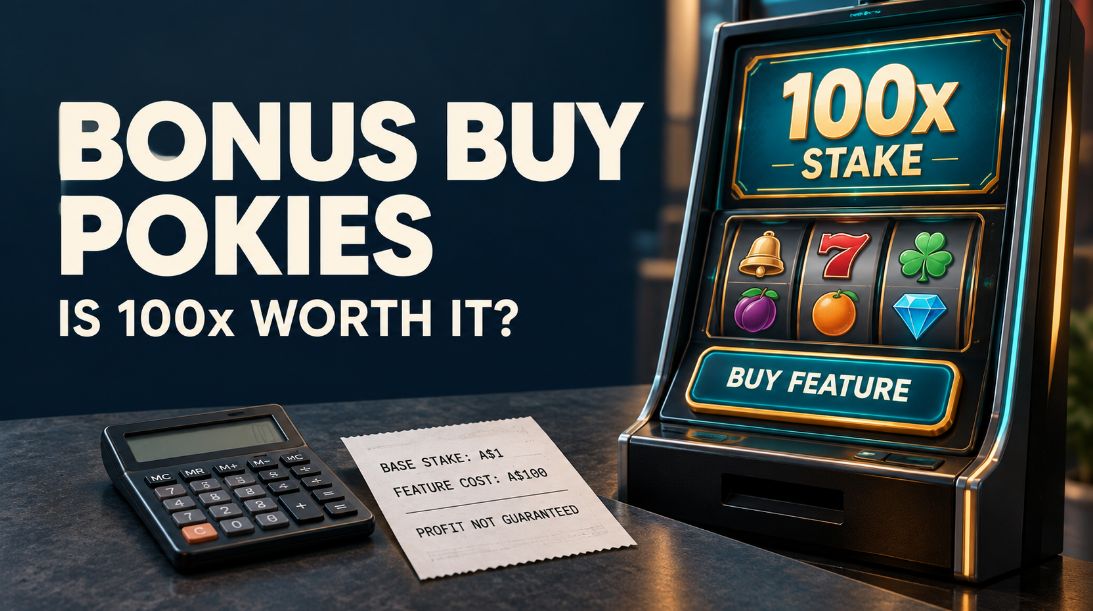
Calling a A$100 purchase a “A$1 bet” hides the relevant financial exposure. The base stake is A$1, but the transaction costs A$100.
Feature purchases can also differ in their starting conditions. One option might provide standard free spins, while another guarantees additional symbols or a different feature. A shared game title does not establish that every purchase option has identical mathematics.
What Does the 100x Price Actually Mean?
The 100x figure is a price multiplier, not a statement about the probability of winning.
It does not mean:
-
One purchase in every 100 will be profitable.
-
The feature returns at least 100x.
-
A natural bonus arrives every 100 spins.
-
The purchase provides 100 separate chances to recover its cost.
-
A large payout becomes more likely after several failed purchases.
Let the base stake be ss. A 100x purchase costs:
If the feature returns XX times the base stake, its cash payout is XsXs. The net result is:
At a A$1 base stake, a feature returning 70x pays A$70. Against the A$100 purchase price, that is a A$30 loss.
The same distinction applies to a celebrated 150x result. It produces a A$50 profit on a A$100 purchase, equivalent to a 50% return on the purchase price—not a 150-fold profit.
The RTP Calculation Behind a Feature Buy
Return to player, or RTP, measures theoretical average payouts as a proportion of stakes.
For a bonus purchase:
Consider a hypothetical feature costing 100x with a buy RTP of 96%.
Its expected payout is:
Its expected net result is:
At different base stakes, the same percentage produces different cash exposure:
| Base stake | Purchase cost | Expected payout | Expected loss |
|---|---|---|---|
| A$0.20 | A$20 | A$19.20 | A$0.80 |
| A$0.50 | A$50 | A$48 | A$2 |
| A$1.00 | A$100 | A$96 | A$4 |
| A$2.00 | A$200 | A$192 | A$8 |
These figures are mathematical expectations, not predicted session results. An individual purchase can finish far above or below the average.
Crucially, use the RTP applicable to the purchase mode. A headline RTP for ordinary play does not, by itself, establish the RTP of every feature-buy option.
Hit Frequency Has Several Different Meanings
“Hit frequency” becomes misleading when it is used without defining a hit.
For a feature buy, at least four measurements are relevant.
Feature-entry frequency
A purchase that guarantees entry successfully starts the specified feature every time it operates according to its rules.
That is an entry guarantee. It says nothing about recovering the purchase price.
Paying-spin frequency
This measures how often individual spins or resolved events within the feature produce a payout.
Frequent small payments can still add up to less than the feature costs.
Non-zero feature frequency
This measures the proportion of purchased features returning any money.
A feature paying A$1 after a A$100 purchase qualifies as a non-zero result, despite losing A$99.
Profitable-feature frequency
This measures how often the total feature payout exceeds its purchase price.
For a 100x purchase:
Cost recovery includes an exactly break-even result:
Those probabilities differ when the game can return exactly 100x.
For evaluating the purchase, profitable-feature frequency is more useful than simply counting rounds with a payment. However, it still does not replace RTP.
A Mathematical Breakdown of Feature-Buy Outcomes
The following hypothetical distribution shows why hit frequency and RTP must be considered separately.
It is an educational model, not measured data from a commercial pokie.
Assume each purchase costs 100x:
| Feature payout | Probability | Contribution to average payout |
|---|---|---|
| 0x | 20% | 0x |
| 20x | 30% | 6x |
| 60x | 25% | 15x |
| 120x | 15% | 18x |
| 400x | 9% | 36x |
| 2,100x | 1% | 21x |
| Total | 100% | 96x |
The expected payout is the sum of each result multiplied by its probability:
Dividing by the 100x purchase price gives 96% RTP.
However, the outcome frequencies tell a different part of the story:
-
80% of purchases return some money.
-
75% return less than the purchase price.
-
25% produce a profit.
-
20% return nothing.
-
1% return 2,100x.
A review could describe this model as having an “80% payout frequency”. That statement would be mathematically correct but incomplete. Three purchases out of four still lose money on average across the distribution.
The median payout is 20x: the cumulative probability reaches 50% at that result. At a A$1 base stake, that represents A$20 returned against A$100 spent.
The mean is much higher because rare large results contribute heavily to the average.
Why RTP Cannot Tell You the Profit Frequency
Knowing that a purchase costs 100x and returns 96% theoretically does not reveal how often it makes money.
Consider two hypothetical features.
Feature A always returns 96x. It has 96% RTP, but no purchase is profitable.
Feature B returns 0x half the time and 192x half the time. It also has 96% RTP:
Yet Feature B produces a profit on 50% of purchases.
Neither is a positive-expectation purchase. Their average financial result is identical, but their experiences are very different.
This is why exact statements such as “one in three buys pays back” require evidence beyond an RTP figure. A maximum prize, volatility label or short demonstration session cannot establish that probability.
Paying Spins Inside the Feature: Another Common Trap
Suppose a hypothetical bonus contains ten independent spins. Each spin has a 20% probability of paying something.
The probability of receiving at least one paying spin is:
That equals approximately 89.3%.
It does not mean the purchased feature has an 89.3% chance of breaking even.
The calculation identifies the chance of at least one payment. It says nothing about the payment amounts or their combined value.
It also relies on an important assumption: independent spins with an unchanged payment probability.
That assumption may not fit a feature with persistent wilds, collected symbols, changing multipliers or retriggers. In those cases, the feature’s state can affect later outcomes.
A useful review must distinguish between a simplified model and the actual game rules.
Is Buying Better Than Waiting for a Natural Bonus?
A natural feature trigger and a purchased feature are different routes through a game.
Ordinary spins may provide base-game payouts while the player waits. A feature purchase skips those spins and charges directly for the specified feature entry.
Suppose a hypothetical game has an independent natural trigger probability of one in 200 per spin.
The expected waiting time is 200 spins. At A$1 per spin, that represents A$200 in expected gross stakes before considering payouts.
It does not mean the expected net cost is A$200. Base-game payments can return part of that turnover.
It also does not guarantee a feature within 200 spins. Under the stated assumptions, the probability of no trigger after 200 spins is:
That is approximately 36.7%.
To compare buying with natural play, the analysis needs:
-
Base-game payouts before the trigger.
-
Natural trigger probability.
-
The distribution of naturally triggered feature types.
-
Purchased-feature starting conditions.
-
RTP for each relevant mode.
Without those details, claiming that a 100x purchase is “half the price of waiting” is not justified.
Purchased Features May Have Different Starting Conditions
Do not assume a bought bonus and a naturally triggered bonus are identical.
The comparison depends on the rules. Relevant differences can include the starting number of free spins, scatter configuration, guaranteed symbols or feature tier.
Some purchases may recreate a standard natural entry. Others may deliberately provide an enhanced starting state.
Even a natural feature can have multiple entry conditions. Triggering with additional scatters, for example, may award a different starting package where the rules specify it.
The correct question is therefore specific:
“Does this purchase produce the same distribution of starting conditions and subsequent outcomes as the natural feature being compared?”
If that information is unavailable, the comparison remains uncertain. A reviewer should not fill the gap with assumptions.
Does a Slightly Higher Buy RTP Make It Worthwhile?
A higher RTP reduces expected loss per dollar wagered, provided the figures apply to the modes being compared.
Suppose ordinary play has a hypothetical RTP of 96%, while a purchase mode has 96.5%.
For A$1,000 of turnover:
| Mode | Expected payout | Expected loss |
|---|---|---|
| 96% RTP | A$960 | A$40 |
| 96.5% RTP | A$965 | A$35 |
The improvement is A$5 per A$1,000 wagered.
That matters mathematically, but it does not eliminate the house edge. It also does not establish the safer session experience.
Speed can overwhelm a modest percentage improvement. Five A$100 purchases create A$500 of turnover. At 96.5% RTP, the expected loss on that turnover is A$17.50.
By comparison, 100 ordinary A$1 spins create A$100 of turnover. At 96% RTP, their expected loss is A$4.
These are different amounts wagered, not a controlled equal-turnover comparison. That is precisely the practical issue: faster access can increase how much money passes through the game.
Losing Streaks Remain Possible After a Profitable Buy
Return to the hypothetical distribution where 25% of purchases are profitable.
Assuming independent purchases with unchanged probabilities:
That is approximately 23.7%.
For ten consecutive losing buys:
These calculations refer to a specified sequence of purchases. They are not the probability of encountering such a streak somewhere during a longer session, which is a different question.
A losing purchase also does not necessarily mean a zero payout. A feature returning 90x still loses 10x against its 100x cost.
Previous losses do not improve the next purchase’s odds under the independence assumption. A feature is not due to compensate for an earlier disappointing result.
Maximum Wins Need the Correct Denominator
A large advertised maximum can dominate attention while revealing little about ordinary outcomes.
Suppose a hypothetical feature advertises a maximum payout of 10,000x the base stake and costs 100x to purchase.
At a A$1 base stake:
-
Purchase price: A$100.
-
Maximum gross payout: A$10,000.
-
Maximum gross payout relative to purchase cost: 100 times.
-
Net profit at that maximum: A$9,900.
The maximum is 10,000 times the base stake, but only 100 times the purchase price.
Neither number tells you how likely that outcome is.
Check whether a stated maximum applies to a single spin, the entire feature or a complete game round. Also check whether reaching the cap ends the feature. These rules affect how the headline figure should be interpreted.
What a Useful Bonus-Buy Review Should Disclose
A technically credible review should identify what is known and what remains unpublished.
The essential information includes:
-
Purchase price in base-stake multiples.
-
Purchase-mode RTP, where disclosed.
-
Starting feature conditions.
-
Whether different purchase tiers use different rules.
-
Maximum payout and its denominator.
-
Any applicable win cap.
-
The source and sample size of observed outcome data.
If a reviewer records results, useful measurements include mean payout, median payout, zero-return frequency and profitable-purchase frequency.
A sample average is not automatically the theoretical RTP. Rare outcomes can materially affect the long-run mean, while remaining absent from a small sample.
Likewise, “I bought ten bonuses” is a session report, not a reliable estimate of the game’s probability distribution.
Australian Consumer Considerations
For an Australian audience, mathematical analysis should not be confused with advice to use offshore online pokies.
ACMA identifies online slots and casino-style games among illegal online services offered to Australians. It also warns that illegal operators do not provide the same consumer protections as licensed services.
A foreign licence, Australian-dollar display or Australian-themed marketing does not establish Australian authorisation.
There is also no mathematical reason to treat a bonus buy as a way to recover losses. Increasing the base stake increases the purchase cost proportionally. Moving from A$1 to A$2 doubles a 100x purchase from A$100 to A$200 without creating an advantage.
If gambling is affecting finances, relationships or wellbeing, Gambling Help Online provides support across Australia. Telephone assistance is available on 1800 858 858.
Final Assessment: Are 100x Bonus Buys Worth It?
A 100x bonus buy can offer immediate access to a feature, but access is not the same as financial value.
The strongest assessment separates three questions:
-
What proportion of the purchase price returns theoretically?
-
How often does the feature recover or exceed its cost?
-
How much money is exposed through repeated purchases?
RTP answers the first question. Outcome-distribution data answers the second. Purchase size and frequency determine the third.
Without that distinction, frequent payments can look like frequent wins, a large maximum can look like good value, and a small base stake can disguise a substantial transaction.
A negative-expectation feature remains a negative-expectation purchase, even when its animations are entertaining and its bonus starts immediately.
Frequently Asked Questions
What does a 100x bonus buy cost in real money?
A 100x bonus buy costs 100 times your selected base stake. At A$0.20 per spin, the purchase costs A$20. At A$1, it costs A$100. The full purchase price—not the displayed base stake—is the amount you risk on that feature.
Does buying a bonus guarantee a profitable result?
No. A bonus buy guarantees entry to the specified feature, not recovery of its cost. If you pay 100x and the feature returns 60x, your net loss is 40x. You break even at exactly 100x and make a profit only when the total payout exceeds the purchase price.
What is the difference between hit frequency and RTP?
Hit frequency measures how often a defined event occurs, such as a paying spin or a profitable feature. RTP measures the theoretical average payout relative to the amount wagered. A feature can produce frequent small payments while still returning less than its purchase price. Neither figure alone tells you the complete payout pattern.
Is buying a feature better value than triggering it naturally?
Not necessarily. A fair comparison requires the purchase-mode RTP, natural trigger probability, base-game payouts and feature starting conditions. Purchased and naturally triggered bonuses may use different entry rules. Comparing a 100x purchase price with the gross cost of waiting ignores money returned during ordinary spins.
How often should a 100x bonus buy return more than it costs?
There is no universal frequency. The answer depends on the feature’s payout distribution, not its price or RTP alone. Two features with identical RTP can have very different chances of returning more than 100x. Without reliable distribution data, an exact profitable-purchase percentage cannot be established.
Sources
- ACMA: Protect yourself from illegal gambling operators — Australian legal context and consumer-protection warnings.
- ACMA: Blocked gambling websites — Enforcement framework for prohibited online gambling services.
- Gambling Help Online — Australian gambling support and counselling.
- ACMA: Gambling website blocking notice — Prohibited services and national gambling support telephone number.