Last Updated on November 1, 2026 by Pokie Player
Key Takeaways
- RTP measures theoretical payouts relative to total money wagered – not the percentage of your deposit you are guaranteed to get back.
- A legal minimum is not a machine’s exact setting. An 85% regulatory floor does not mean every pub pokie operates at 85%.
- Some online slots publish returns around 96%, but online games do not universally offer 95% or more. Check the relevant configuration and playing mode.
- At equal turnover, higher RTP reduces expected loss. A$1,000 wagered at 90% RTP produces an expected A$100 loss, compared with A$40 at 96%.
- Higher RTP does not guarantee longer play. Larger stakes, faster betting and greater volatility can outweigh the percentage advantage.
- The cabinet is not the cause: pub pokies are computer-controlled games too. Their configured mathematics determine theoretical return.
- Offshore online casinos are not an Australian-authorised substitute for local venues. A higher advertised RTP does not guarantee accurate game information or reliable withdrawals.
Pub Pokies vs Online Slots: What RTP Really Means for Your Money
A pub pokie with a lower return to player can lose money faster, on average, than a higher-RTP online slot – provided the stake, number of bets and other conditions are comparable.
However, two assumptions need correcting.
First, a legal minimum is not necessarily the return configured on the machine. A state allowing an 85% minimum does not mean every local pub pokie operates at 85%.
Second, online slots do not universally return 95% or more. A published figure applies to a particular game configuration, not every website, version or playing mode.
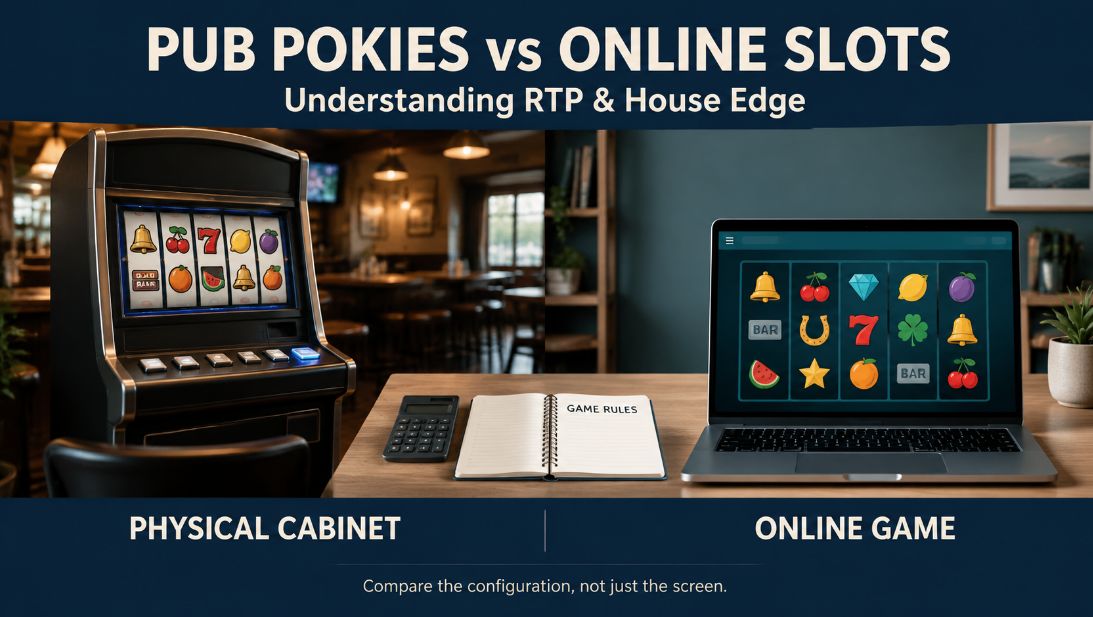
The difference also has nothing inherently to do with physical cabinets being less generous than digital games. Modern pub pokies are computer-controlled games themselves. Their payout mathematics are designed and configured within the applicable regulatory framework.
The useful comparison is between verified game settings – not between a cabinet and a screen.
For Australian readers, there is another essential distinction: online casino games and pokies are prohibited services for operators to provide to customers in Australia. A higher advertised RTP does not make an offshore service Australian-authorised or resolve withdrawal and consumer-protection risks.
This guide explains the state minimums, the mathematics behind the gap and why a higher RTP does not guarantee that your money will last longer.
What RTP Actually Measures
Return to player, or RTP, describes the theoretical proportion of total stakes returned through payouts over extensive play.
A game with 90% RTP has a theoretical average return of A$90 for every A$100 wagered.
The remaining A$10 represents its expected gross gambling margin before operating expenses and other business costs.
The key word is turnover.
RTP applies to cumulative money wagered, including money returned as prizes and then bet again. It does not promise that you will recover a stated percentage of your opening balance.
If you insert A$50, receive several payouts and keep playing, your total stakes can become much larger than A$50.
You could eventually lose the entire balance despite playing a game whose theoretical return is 90% or 96%.
For an individual visit, random variation can overwhelm the average.
Australian Pub Pokie Minimums: What Official Sources Say
There is no single national RTP minimum covering every Australian gambling venue and product.
State rules, approval requirements and measurement arrangements matter. Pub and club requirements should also not automatically be applied to casinos.
The following examples illustrate why precise wording matters.
| Jurisdiction | Officially stated requirement or guidance | What not to assume |
|---|---|---|
| New South Wales | Gaming machines must return at least 85% over the full course of combinations | Every machine is configured at exactly 85% |
| Victoria | Current VGCCC guidance lists an 85% minimum for hotel and club venues and notes calendar-year calculation | An individual session must return 85% |
| Queensland | Official staff-training guidance describes returns between 85% and 92% over extensive play | Every game shares one payout rate or prize structure |
These are regulatory floors or jurisdiction-specific explanations, not a survey of the actual setting on every machine.
Victoria is particularly worth checking against current information. The regulator’s guidance updated in October 2026 states 85% for hotel and club venues. Repeating an older percentage without verifying the applicable rule can produce a misleading comparison.
Legal Minimum, Configured RTP and Actual Results Are Different
Three figures can appear in discussions about pokies.
The legal minimum
This is the relevant regulatory requirement.
It establishes a boundary. It does not identify the exact approved configuration of every machine.
The configured theoretical RTP
This is the return associated with a particular game setup.
A machine can operate above the legal floor. A different approved version of a similar game may have different mathematics.
The observed return
This is what happened during a particular sample of play.
It might describe your session, a machine’s recorded activity or a larger group of machines over a reporting period.
Observed results can differ from theoretical expectations, especially over small samples.
Confusing these categories produces statements such as “the law says 85%, so this machine took exactly 15%”. That is not how individual outcomes work.
Why Some Online Slots Advertise Higher RTP
Some online game specifications publish returns in the mid-90s.
For example, Pragmatic Play’s official pages list 96.50% for Gates of Olympus and Voodoo Magic.
Those are concrete examples of published online-game figures. They do not prove that every online slot returns at least 95%, or that every instance encountered on an offshore website uses the same setting.
A higher RTP is a design and commercial choice within the rules governing the particular product.
A business model can operate with a smaller expected margin per dollar if other conditions support it. Those conditions might include turnover, costs and the overall product offering.
However, that commercial explanation is not proof of why a particular developer selected 96.50%, or why a particular pub installed a given configuration.
The defensible conclusion is narrower: different approved or published game mathematics can produce different expected returns.
Physical Cabinets Are Digital Games Too
The phrase “physical pokies versus digital slots” can create a false distinction.
Queensland’s official training guidance explains that gaming machines use computer programs and random-number generation to determine outcomes.
The cabinet provides the screen, controls, payment handling and physical presentation. It does not inherently dictate a low RTP.
Similarly, moving a game onto a phone does not mathematically require a high return.
The relevant questions are:
-
What is the game’s payout structure?
-
What configuration is operating?
-
What rules apply?
-
What stake or mode is selected?
-
Is the published information reliable?
A brightly lit cabinet can have one theoretical return, while an online game can have another. The screen location alone does not explain the difference.
Do Pub Costs Explain Lower Returns?
Physical venues have operating costs. So do online businesses.
It is tempting to conclude that pub rent, staff and electricity directly explain every percentage-point difference in RTP.
That claim goes too far.
Operating costs can influence commercial decisions, but a game does not calculate the venue’s expenses and then adjust its next spin to pay them.
There is also a difference between gross gambling revenue and profit.
If A$1,000 in turnover produces an expected A$100 gambling margin, that A$100 is not automatically the venue’s final profit. Taxes, supplier arrangements and operating expenses may still apply.
A useful explanation connects economics with game configuration without inventing a direct relationship between a pub’s electricity bill and your next result.
The Mathematics of 85%, 90% and 96% RTP
For a straightforward comparison:
At equal turnover, a higher RTP produces a lower expected loss.
| Total turnover | 85% RTP | 90% RTP | 96% RTP |
|---|---|---|---|
| A$100 | A$15 expected loss | A$10 expected loss | A$4 expected loss |
| A$500 | A$75 expected loss | A$50 expected loss | A$20 expected loss |
| A$1,000 | A$150 expected loss | A$100 expected loss | A$40 expected loss |
These are expectations, not session forecasts.
The difference between 90% and 96% RTP is six percentage points. The corresponding house edge falls from 10% to 4%.
At equal turnover, that represents a 60% reduction in expected loss – not merely a 6% reduction.
The distinction is mathematically important. It still does not turn a negative-expectation game into a profitable one.
Why Your A$100 Can Generate Much More Than A$100 in Bets
Imagine a hypothetical player starting with A$100.
They make 100 bets of A$1. Along the way, payouts return credits to the balance. Those credits can fund later bets.
If sufficient credits remain, another 100 A$1 bets add another A$100 to turnover, even without an additional cash deposit.
The same money can circulate through the game repeatedly.
This is why RTP should not be described as a deposit refund percentage.
An 85% return does not mean the machine must leave A$85 from an opening A$100. Nor does 96% mean an online account can lose only A$4.
NSW’s official gaming-machine information specifically distinguishes turnover from player losses. The first measures total bets; the second measures the net financial outcome.
Both figures are useful, but they answer different questions.
Does Higher RTP Mean Your Balance Lasts Longer?
All else being equal, a higher RTP reduces the expected loss on the same amount wagered.
That makes it a meaningful mathematical advantage in a controlled comparison.
However, “all else being equal” is doing considerable work.
Your session also depends on:
-
Stake size.
-
Number of bets.
-
Playing speed.
-
Volatility.
-
Feature purchases.
-
Starting balance.
-
When you stop.
-
Random outcomes.
A lower-RTP game can produce a profitable session. A higher-RTP game can exhaust a balance quickly.
RTP alone cannot establish the expected time until your money runs out. That requires more information about the distribution of payouts and how you play.
The accurate conclusion is lower expected loss per dollar wagered – not guaranteed extra minutes.
Faster Play Can Reverse the Hourly Comparison
Consider two hypothetical sessions with unchanged game conditions.
In the first, a player makes 300 bets of A$1 at 90% RTP.
Turnover is A$300. Expected loss is A$30.
In the second, a player makes 900 bets of A$1 at 96% RTP.
Turnover is A$900. Expected loss is A$36.
The second game has the higher RTP but the greater expected loss over the stated period because the player wagers three times as much.
These are illustrative rates, not claims about typical pub or online behaviour.
They show why speed matters.
A smaller margin applied to substantially more turnover can still produce a larger expected cost. Comparing RTP without comparing bet frequency leaves out an important part of the experience.
Stake Size Can Matter More Than the Percentage Gap
Now hold the number of bets constant at 300.
A hypothetical 90% RTP game played at A$0.50 per bet produces A$150 in turnover and A$15 in expected loss.
A hypothetical 96% RTP game played at A$2 per bet produces A$600 in turnover and A$24 in expected loss.
Again, the higher-RTP session has the greater expected loss because the stake is much larger.
Do not confuse denomination with total stake either.
A “one-cent machine” can involve multiple lines, credits or other betting components. Queensland’s training material uses this distinction to explain how apparently small denominations can generate substantial turnover.
Read the full bet amount, not just the smallest monetary label on the screen.
RTP and Volatility Explain Different Things
RTP describes the average theoretical return. Volatility describes how widely results vary around that average.
A game can concentrate a meaningful share of its return in infrequent large prizes. Another can distribute more return through smaller payments.
Two games with the same RTP can therefore feel very different.
A highly variable game may deliver long stretches with little return before an occasional substantial result. Another may produce more regular credits without generating a profit.
Neither experience changes the need to compare payouts with stakes.
A return of A$0.40 on a A$1 spin is a A$0.60 net loss, even if the game celebrates it.
For a deeper explanation, an RTP-versus-volatility guide should examine average return, payment frequency and profitable-result frequency separately.
Jackpots Complicate Simple Comparisons
A headline RTP may include jackpot and feature contributions according to the game’s rules.
If part of the return is concentrated in rare outcomes, many individual sessions will not resemble the average.
You also need to know whether the quoted figure applies to:
-
The selected stake.
-
The chosen game mode.
-
Jackpot eligibility.
-
An optional feature.
-
A separate feature purchase.
Do not assume that adding an extra wager increases value simply because it unlocks another prize.
Likewise, a large jackpot display does not establish that a game is near a payout or that your next bet has become profitable.
The relevant probabilities and eligibility conditions matter more than the size of the number above the reels.
Can You Check a Pub Machine’s Exact RTP?
Sometimes game information helps, but it may not provide everything needed for a confident comparison.
Review the machine’s rules, help screens and applicable information. Ask venue staff where approved game information can be found.
Do not infer the setting from a machine’s appearance, location or recent results.
A machine near the entrance is not necessarily more generous. A quiet cabinet is not necessarily due to pay.
Also avoid estimating theoretical RTP from a handful of spins. Short samples can be dominated by chance.
For online specifications, distinguish the developer’s published information from the configuration actually supplied. A title-level claim is not enough if the relevant version or mode is unclear.
If the setting cannot be verified, describe it as unknown rather than substituting a legal minimum.
The Australian Legal Gap Cannot Be Ignored
A mathematical comparison is not a recommendation to move from a local pub to an offshore casino.
Australian pubs and clubs operate within state regulatory systems. Offshore online casino services offered to Australians are not an equivalent Australian-authorised alternative.
ACMA warns that illegal operators may lack important consumer protections and that recovering money can be difficult.
A published 96% RTP does not protect you if an operator refuses to release a balance.
It also does not prove that the stated game is genuine or the displayed setting is accurate.
These are separate questions:
-
What return does the game theoretically offer?
-
Is the operator authorised, accountable and reliable?
A favourable answer to the first does not establish the second.
Why One Session Cannot Prove Online Is Better
Personal experience can reveal how a session felt. It cannot, by itself, establish the reason.
Perhaps your online stake was smaller. Perhaps you played fewer bets, received an unusually large feature or stopped sooner.
Perhaps the pub session involved higher volatility.
Without controlling those factors, “my money lasted longer” is an observation – not proof that the online RTP caused the difference.
Memory can also give substantial wins more attention than routine losses. Keeping accurate records of deposits, withdrawals and time spent provides a clearer picture than remembering highlights.
Do not continue gambling to collect enough data to prove a theory. The extra exposure is real, while a reliable estimate may require far more play than expected.
A Better Way to Read Any RTP Comparison
Use a consistent checklist:
-
Separate the legal floor from the configured return.
-
Compare the same amount of turnover.
-
Check stake and playing speed.
-
Identify volatility and jackpot conditions.
-
Distinguish theoretical figures from observed results.
-
Verify the applicable game version.
-
Consider operator protection separately.
-
Avoid treating any RTP as a session guarantee.
This framework is more useful than a blanket claim that pubs return 85% and online games return 96%.
An introductory RTP guide can explain the core formula. A volatility guide can explain uneven outcomes. A feature-buy guide can show why a purchase price changes the relevant break-even point.
Together, those topics explain the mathematics without promising a winning system.
Final Verdict: The Configuration Matters More Than the Cabinet
Some published online slot returns are higher than the minimums applying to Australian pub and club machines.
That difference can materially reduce expected loss at equal turnover.
But the legal floor is not every machine’s actual setting, online games do not universally return 95% or more, and a higher RTP does not guarantee a longer session.
The most accurate comparison considers configuration, turnover, stake, speed and volatility together.
For Australians, it must also acknowledge that offshore online casinos are not a like-for-like regulated substitute for a local venue.
Use RTP to understand a game’s expected cost – not to justify more spending or chase earlier losses.
If gambling is becoming difficult to control, free, confidential support is available on 1800 858 858.
Sources
- GambleAware NSW: Turnover, player losses and the 85% minimum return requirement
- NSW Parliament: Regulation of gaming machines and minimum RTP
- VGCCC: Current minimum RTP guidance for Victorian hotels and clubs
- Business Queensland: Gaming-machine operation, return percentages and betting misconceptions
- GambleAware NSW: Independent spins, long-run returns and gambling harm
- Pragmatic Play: Published Gates of Olympus game information and RTP
- Pragmatic Play: Published Voodoo Magic game information and RTP
- ACMA: Illegal online casino services and consumer-protection risks
- Commonwealth Bank: Gambling-harm assistance and national support contacts