Last Updated on November 2, 2026 by Pokie Player
Summary
- TITO vouchers can provide quick Australian-dollar cash at a local RSL or club when the ticket is valid and the payout qualifies for cash redemption.
- Larger payouts are not always immediate. NSW and Victoria have different thresholds and non-cash payment requirements.
- Crypto casino withdrawals involve several stages: operator approval, possible identity checks, blockchain processing and destination crediting.
- “Instant withdrawal” does not necessarily mean spendable money. Converting crypto into AUD can add fees, verification and delays.
- Neither method guarantees anonymity. Venues, operators and receiving platforms may require identification.
- Offshore crypto casinos are not equivalent to Australian-licensed gaming venues. Cryptocurrency does not change the prohibition on operators providing online casino games to Australians.
Cashing Out: TITO Vouchers vs Crypto Casino Withdrawal Processes
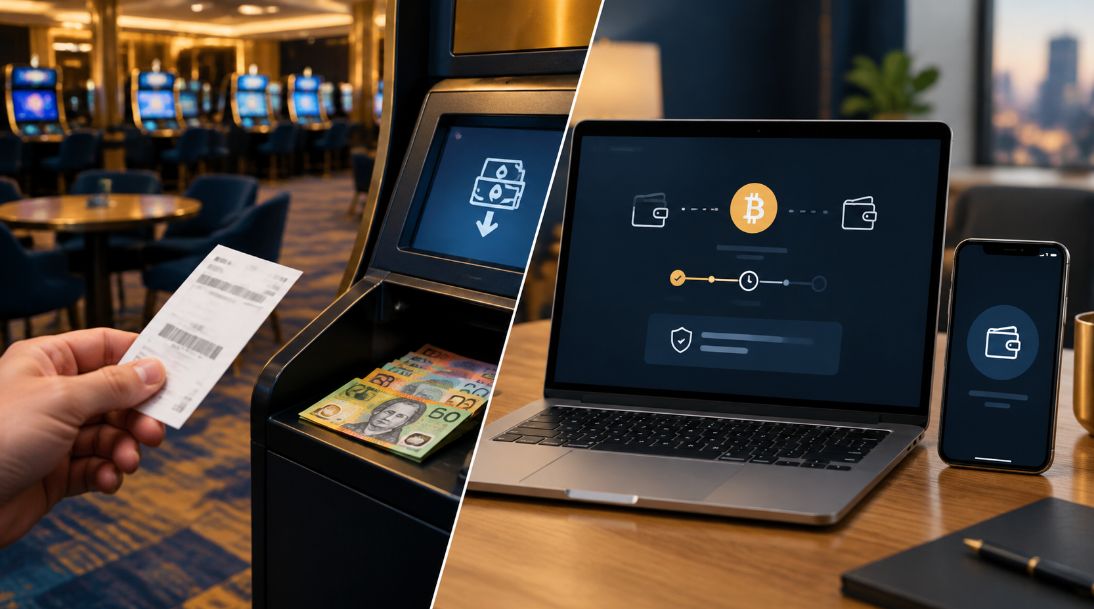
For a modest payout at a local RSL, redeeming a Ticket-In, Ticket-Out voucher can be straightforward: finish playing, collect the printed ticket and redeem it at an approved terminal or cashier.
A cryptocurrency casino withdrawal usually involves more stages. The operator must process the request, any required checks must be completed, a blockchain transaction must be sent and the destination must recognise the payment.
If you then want Australian dollars in your bank account, there may be another conversion and withdrawal process.
That makes “instant payout” a surprisingly slippery phrase.
Does it mean the operator approved your request? The coins reached your wallet? Or the money became available to spend at the supermarket?
The most useful comparison focuses on availability: when you actually control the funds in the form you need.
There is also an important Australian legal distinction. A licensed local gaming lounge and an offshore crypto casino are not equivalent regulated services. Online casino games are prohibited services for operators to provide to customers in Australia. Accepting cryptocurrency does not change that position.
This guide compares the practical payout journeys, explains identification requirements and shows why a printed voucher can be convenient without making every physical payout immediate.
What Is a TITO Voucher?
TITO stands for Ticket-In, Ticket-Out.
Instead of dispensing coins when you collect credits, a compatible gaming machine prints a ticket representing the redeemable balance.
The ticket contains identifying information that allows the venue’s system to validate it. Depending on the approved system, it can be redeemed or used in compatible equipment within that system.
It is not a universal voucher accepted at every RSL, club or casino.
In NSW, official material describes required ticket information including the issuing venue, ticket identifier and accumulated-credit value.
The voucher’s amount also does not necessarily represent profit.
If you insert A$100, play and collect A$70, the ticket represents A$70 available for redemption – not a A$70 win.
Keeping the payout amount separate from your net result is essential.
What Happens at a Cash Redemption Terminal?
For an ordinary eligible ticket, the process is usually simple:
-
Take the ticket to the venue’s approved redemption terminal.
-
Follow the displayed instructions.
-
Insert or scan the voucher as directed.
-
Allow the system to validate it.
-
Collect the money and any other output.
-
Check that the amount is correct.
In NSW, gaming-machine tickets must be redeemed by an authorised person or through an approved cash-back terminal.
The system needs to recognise the ticket as valid and unpaid. A ticket that has already been redeemed cannot legitimately be paid again.
If validation fails, speak to staff rather than repeatedly forcing a damaged ticket into the machine.
A terminal may also be unavailable, require staff assistance or be unsuitable for the particular payout.
“Cash in hand” is convenient, but it remains subject to the ticket, equipment and applicable rules.
TITO vs Crypto: The Main Differences
| Question | TITO redemption | Crypto casino withdrawal |
|---|---|---|
| Starting point | A printed voucher representing recorded credits | An operator-controlled account balance |
| Initial action | Present the ticket for redemption | Submit a withdrawal request |
| Validation | Venue system checks the ticket | Operator reviews eligibility and applicable checks |
| Typical destination | Cash, or another permitted payout method | A supported wallet or custodial platform |
| Identification | May be required depending on circumstances | May be required by the operator and receiving provider |
| Additional settlement | Often limited for an eligible cash payout | Blockchain processing and destination crediting |
| Australian dollars available? | Yes, if paid in AUD cash | Not necessarily; conversion may be needed |
| Main complication | Invalid ticket, equipment issue or payout rules | Approval delays, verification, network or destination issues |
| Regulatory position | Local venue subject to applicable Australian rules | Offshore casino is not an equivalent Australian-authorised service |
There is no defensible universal time guarantee for either route.
When a Local Payout Is Not Immediate Cash
The claim that physical venues always pay instantly is incorrect.
State payout rules can require cheque or electronic payment for larger amounts. Those arrangements can include delays.
Rules also differ between jurisdictions. Do not assume a NSW threshold applies in Victoria or that a pub rule automatically applies to a casino.
NSW: Amounts Above A$5,000
NSW Government guidance states that, where a person claims a gaming-machine prize exceeding A$5,000, the amount above A$5,000 must be paid within 48 hours by crossed cheque or, where available, electronic funds transfer.
If the prizewinner requests the whole amount through one of those methods, the venue must comply.
For example, a hypothetical A$5,200 payout is not automatically a A$5,200 cash-terminal transaction. The amount above the threshold is subject to the non-cash requirement.
The payment rule concerns the relevant payout – not simply the amount you consider profit after subtracting your original cash.
Victoria: A$2,000 or More
Victoria’s regulator states that accumulated gaming-machine credits worth A$2,000 or more must be paid by cheque or qualifying electronic funds transfer.
For an EFT of at least A$2,000, the money must not be accessible for 24 hours after transfer. If that arrangement is unavailable, payment must be by cheque.
This is a deliberate regulatory condition, not necessarily a processing failure.
Ask Before Assuming
For any substantial payout, ask staff:
-
Which payment rule applies?
-
What identification is needed?
-
When will payment be made?
-
When can the funds actually be accessed?
-
What written record will I receive?
Do not divide transactions to evade reporting or payout requirements.
Is TITO Redemption Anonymous?
Not reliably – and it should not be presented as a way to avoid identification.
An ordinary low-value ticket may be redeemed without the same document-upload process encountered online. However, that does not establish anonymity.
Venue entry, membership, monitoring, payment records and legal requirements can all matter.
Victorian guidance, for example, explains that supporting identification may be retained for cheque and EFT payments and that relevant payment information is recorded.
NSW investigative material also describes circumstances in which ticket-redemption records include claimant identity.
The accurate comparison is that routine TITO redemption can involve fewer visible steps – not that physical venues have no identity or anti-money-laundering controls.
Bring appropriate identification when visiting a venue, particularly if collecting a substantial amount.
Protect the Ticket Until It Is Redeemed
A TITO voucher is small, easily misplaced and dependent on readable identifying information.
Keep it dry, intact and away from anything likely to damage the print.
Check the amount before leaving the machine. If the printer fails or produces an unreadable ticket, call staff immediately and identify the machine involved.
Do not post a photograph of the barcode or ticket identifier online.
A photo may help document a problem, but it is not a guarantee that the venue will pay without the original ticket or further checks.
If the voucher is lost, contact the venue promptly. Provide the approximate issue time, machine location and amount.
Do not assume a lost voucher can always be cancelled or replaced.
Do TITO Tickets Expire?
Yes, and the applicable rules matter.
NSW Government guidance states that gaming-machine tickets expire 12 months after issue and cannot be redeemed after expiry.
For tickets worth A$10 or more, venues have specified notice obligations before expiry. Expired amounts are subsequently handled under the state’s unclaimed-money arrangements.
Do not interpret this as a national rule applying identically everywhere.
Check the ticket and ask the issuing venue about its jurisdiction’s requirements.
The practical approach is to redeem promptly rather than leave a ticket in a wallet for months.
Also distinguish an expired ticket from a damaged or temporarily unreadable one. Those are different problems and may require different handling.
Why a Crypto Withdrawal Has More Stages
A crypto withdrawal is not a single event.
It usually involves several separate systems:
-
The casino account and withdrawal queue.
-
Any operator verification or review.
-
Transaction creation and broadcast.
-
Blockchain processing.
-
Destination-wallet or platform recognition.
-
Optional conversion into Australian dollars.
-
Optional withdrawal to a bank.
The blockchain only becomes relevant once a transaction has actually been submitted to it.
An operator advertising a fast network does not establish that its own approval process is fast.
Similarly, a transaction visible on-chain does not guarantee that a receiving exchange has credited it for use.
The total journey depends on every stage, not the fastest component.
What KYC Means at Withdrawal
KYC means “know your customer”. It forms part of customer due diligence.
Depending on the business, jurisdiction and circumstances, checks can involve identity, address, account ownership and the source of funds.
Possible requests include an accepted identity document, address evidence or additional information about particular transactions.
However, offshore casinos do not all follow one universal verification standard. Their policies and legal obligations vary.
Do not assume every document request is legitimate simply because support calls it KYC.
Verify the requesting business and use a secure, independently checked channel.
Never provide a banking password, one-time authentication code or wallet recovery phrase.
Legitimate identity verification does not require handing over control of your bank account or private wallet.
Why Verification Can Reappear Later
“Verified once” does not always mean “never checked again”.
AUSTRAC explains that regulated businesses may need to review and update customer information according to risk and changing circumstances.
An Australian exchange receiving or converting crypto can therefore conduct its own checks, separate from an offshore casino.
That does not mean every withdrawal requires a fresh passport upload.
It means the receiving provider’s obligations and risk controls do not disappear because another business previously approved the customer.
Also keep the legal roles distinct. AUSTRAC supervision of an Australian virtual-asset provider does not certify an offshore casino or guarantee its payment.
Registration and compliance obligations are not an endorsement of every transaction entering the platform.
“No KYC” Is Not a Payout Guarantee
A “no KYC” advertisement may describe limited checks at one stage, not an unconditional right to withdraw indefinitely without questions.
Read the terms rather than relying on the headline.
The operator may reserve the ability to request documents, review transactions or restrict accounts.
Conversely, an operation with genuinely weak checks may offer less accountability – not better protection.
Do not give false personal information to avoid verification. Inaccurate details can complicate disputes and account access.
Most importantly, a business accepting a deposit without documents has not promised that a later payout will be frictionless.
Easy entry and dependable exit are different qualities.
Understanding Pending, Sent and Confirmed
Withdrawal-status labels are not standardised across operators.
“Pending” can mean an internal request is awaiting action. “Processing” may describe several different stages.
Ask for a clear explanation rather than inferring progress from the label.
If the operator says a crypto transfer has been sent, request the transaction identifier and relevant network information.
A valid on-chain record can help establish whether a transfer was broadcast, its destination and its confirmation status.
However, a missing identifier does not conclusively prove nothing was sent; the interface or support response may be incomplete.
Likewise, a displayed identifier is not enough by itself. It needs to correspond to the correct transaction.
Never share private keys or recovery phrases while seeking help.
Crypto in a Wallet Is Not Cash in Hand
This is the biggest practical difference in the comparison.
An eligible TITO redemption can leave you holding Australian notes.
A crypto payout can leave you holding a digital asset whose Australian-dollar value may change and which may not be directly usable for your intended purchase.
To reach a bank balance, you may need an exchange or another service, a conversion and a withdrawal.
Each step can introduce conditions, fees or delays.
Stablecoins do not remove every issue. They still involve supported networks, destination requirements and issuer or platform risks.
Compare equivalent endpoints:
-
Voucher to AUD cash.
-
Casino balance to crypto wallet.
-
Casino balance to spendable AUD.
Those are three different timing questions.
Fees Can Change the Final Amount
A physical cash redemption and a crypto withdrawal can also have different cost structures.
For crypto, possible costs include:
-
Operator withdrawal charges.
-
Network transaction fees.
-
Receiving-platform conditions.
-
Conversion fees or spreads.
-
Bank-withdrawal charges where applicable.
A hypothetical A$100-equivalent withdrawal is not necessarily A$100 in your bank after all stages.
“Free withdrawal” may refer only to the operator’s own charge.
Read whether an amount is quoted before or after fees and whether minimum thresholds apply.
Do not assume a low network fee means low total cost. The conversion spread or platform fee can matter more.
For a venue payout, ask staff about the permitted method and amount rather than accepting an unexplained deduction.
Two Scenarios That Show the Difference
Consider a hypothetical A$180 TITO ticket at a local club.
If the ticket is valid, the approved terminal is operating and cash redemption is permitted, the process may finish during the visit.
Now consider a A$180-equivalent offshore crypto balance.
The operator may review the request, require checks, send the transaction and wait for network processing. A receiving platform may then apply its own crediting conditions.
Neither scenario establishes a guaranteed time.
The contrast also changes at larger amounts. A A$3,000 Victorian gaming-machine payout falls under the state’s non-cash requirements, so describing it as instant notes from a terminal would be wrong.
The correct lesson is not “physical always wins”. It is that amount, jurisdiction and destination determine the actual experience.
What to Do When a Payout Fails
At a Physical Venue
Keep the ticket and ask for the duty manager.
Record the amount, machine or terminal involved, approximate time and explanation provided.
Request written acknowledgement if payment remains unresolved.
Use the venue’s complaint process and contact the relevant state regulator where appropriate.
With an Offshore Operator
Save the withdrawal request, account history, messages and any transaction information.
Ask what specific stage is incomplete and what action is required.
Do not make another deposit to “activate” or release the payout.
ACMA can receive reports about illegal gambling services, but reporting does not guarantee recovery. An offshore dispute may be much harder to enforce than a local venue complaint.
Beware of recovery agents demanding upfront fees.
Final Verdict: Compare the Whole Payout Journey
TITO offers a clear convenience for ordinary eligible redemptions: a recorded venue balance can become Australian-dollar cash without a separate exchange or blockchain process.
But larger payouts, identification, damaged tickets and state rules can change that experience.
Crypto withdrawals involve more handoffs. Operator approval, verification, network processing and conversion are separate stages, each capable of affecting timing and access.
For Australians, the regulatory difference is equally important. Offshore crypto casinos are not an equivalent authorised alternative to a local RSL gaming lounge.
Judge a payout by when you control usable funds – not by a slogan about seconds.
If gambling or delayed withdrawals are creating financial stress, free, confidential support is available on 1800 858 858.
Frequently Asked Questions
What is a TITO voucher?
A Ticket-In, Ticket-Out voucher is a printed ticket representing credits collected from a compatible gaming machine. You can redeem a valid ticket through the issuing venue’s approved terminal or cashier, subject to applicable payout rules.
Is redeeming a TITO voucher faster than a crypto casino withdrawal?
For an eligible cash payout, TITO redemption can involve fewer steps. Crypto withdrawals may require operator approval, identity verification, blockchain processing and destination crediting. Neither method guarantees immediate payment, particularly when larger payouts or additional checks are involved.
Do you need identification to cash out a TITO ticket?
Identification may be required depending on the payout, venue procedures and applicable legal requirements. A routine terminal redemption does not necessarily involve uploading documents, but that does not make the transaction anonymous. Larger cheque or electronic payments can involve identity checks and recordkeeping.
Why can a crypto casino withdrawal remain pending?
A pending withdrawal may still be awaiting operator approval, verification or another internal review. Once a transaction is broadcast, blockchain processing and the receiving platform’s requirements can affect when funds become available. Ask the operator which stage remains incomplete rather than assuming the blockchain is responsible.
Does receiving crypto mean the money is ready to spend in Australia?
Not necessarily. Receiving cryptocurrency is different from receiving Australian dollars. You may need to transfer the asset to a supported exchange, complete verification, convert it into AUD and withdraw to your bank. Those additional stages can involve fees and delays.
Sources
- NSW Government: Gaming-machine payouts, ticket redemption and amounts above A$5,000
- NSW Government: Gaming-machine ticket expiry and unclaimed prizes
- VGCCC: Victorian payout thresholds, EFT delays, identification records and payment registers
- NSW Crime Commission: Ticket information, redemption records and accumulated credits
- AUSTRAC: Customer identification and additional due-diligence requests
- AUSTRAC: Reviewing and updating customer information
- CryptoDaily: Operator approval, blockchain settlement and destination crediting
- ASIC Moneysmart: Crypto-asset risks
- ACMA: Illegal offshore gambling services and consumer-protection limitations
- Scamwatch: Money-recovery scams and upfront-fee warnings