Last Updated on November 20, 2026 by Pokie Player
Summary
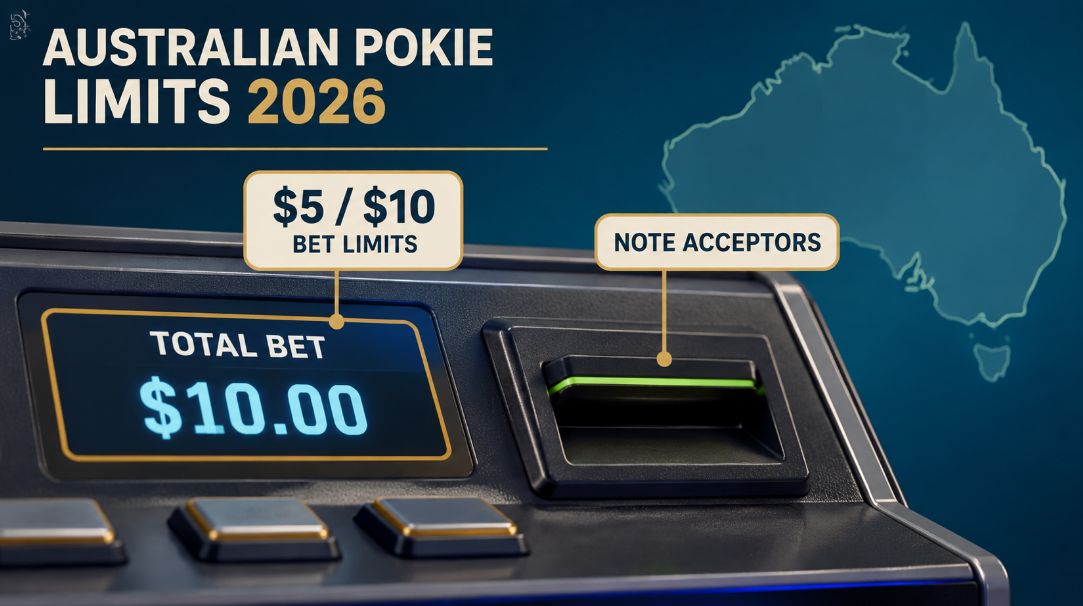
Australian pokie limits vary by state, venue type and machine approval. The maximum stake per spin, accepted banknote denominations and cash-loading restrictions are separate rules—not recommended spending limits.
- Maximum bets: Ordinary pub and club pokies generally allow up to $10 per spin in NSW and the ACT, compared with $5 in Victoria, Queensland, South Australia, Tasmania and the Northern Territory.
- NSW: The $500 input requirement applies to machines installed under newer rules from 1 July 2023. Older approvals can differ.
- Victoria: Hotel and club machines have a $100 cash load-up limit and cannot accept notes above $50. TITO tickets have different treatment.
- Queensland: Pub and club machines have a $100 loading parameter, although $50 and $100 notes are permitted.
- South Australia: Notes up to $50 are permitted, but note acceptance stops when the existing balance reaches $100. This is not a hard ceiling on the possible credit balance.
- Tasmania: Hotel and club pokies cannot have banknote acceptors. Casino machines operate under separate cash-input rules.
- ACT: Do not confuse proposed $5 bets and $100 loading limits with implemented requirements.
- Northern Territory: Hotel and club machines have a published $1,000 loading threshold.
- Western Australia: There are no pub or club pokies. Casino electronic gaming machines have separate approvals.
A loading limit is not a daily loss limit. Check the total dollar stake before playing, count repeat loads towards the same personal budget and never treat the machine’s permitted maximum as a target.
Pokie Bet Limits and Note Acceptors in Australia: 2026 State-by-State Guide
Australian pokie limits are not uniform. An ordinary pub or club machine can permit a maximum $10 bet in New South Wales, while comparable machines in Victoria, Queensland, South Australia, Tasmania and the Northern Territory generally have a $5 maximum.
Cash-loading rules create another layer of differences. Victoria now applies a $100 cash load-up limit in hotels and clubs. New South Wales introduced a $500 input limit for machines entering service under its newer requirements, but older machines may operate under different approvals. Tasmania does not permit banknote acceptors on hotel and club gaming machines.
The important distinction is that a maximum bet, an accepted banknote denomination and a machine’s loading threshold are three different things. None is a recommended gambling budget.
This guide explains those differences across all eight states and territories, with a focus on avoiding surprises at the machine.
Rules reviewed for November 2026. The main comparison concerns ordinary land-based gaming machines in hotels and clubs, where permitted. Casino exceptions are identified separately. This is a practical consumer guide, not a substitute for an operator’s licence conditions or current regulatory advice.
Australian Pokie Limits at a Glance
| State or territory | Maximum bet on ordinary hotel or club pokies | Note acceptor or loading position | Important qualification |
|---|---|---|---|
| New South Wales | $10 | $500 input limit under requirements applying to machines installed from 1 July 2023 | Older approvals may differ; the newer rule covers more than banknotes |
| Victoria | $5 | $100 cash load-up limit; banknotes above $50 prohibited | TITO tickets are treated differently; some older-protocol machines have a lower cash threshold |
| Queensland | $5 | $100 banknote-loading parameter; $50 and $100 notes permitted | Casino loading settings differ |
| South Australia | $5 | Notes up to $50; note acceptance stops when the existing balance is $100 or more | This is not the same as a hard $100 maximum balance |
| Tasmania | $5 | Banknote acceptors prohibited in hotels and clubs | Casino machines may have note acceptors, with a $500 cash-input limit |
| Australian Capital Territory | $10 | No general statutory machine credit limit identified in the official material reviewed | Proposed $5 bets and $100 loading limits should not be confused with implemented rules |
| Northern Territory | $5 | All Australian banknotes accepted; published loading threshold is $1,000 | Casino rules differ |
| Western Australia | Not applicable: no pub or club pokies | Not applicable | Casino electronic gaming machines operate under separate approvals |
The table is a starting point. Loading restrictions can depend on the machine’s approval, its current credit balance and whether money arrives as cash, a ticket or an electronic transfer.
Understand the Four Different Limits
Maximum bet per play
The maximum bet is the highest total stake permitted on a paid play, commonly described as a spin.
It is not necessarily the amount shown beside a single credit, line or denomination button. A “1 cent” machine can still allow a multi-dollar total bet once credits and lines are combined.
Check the total monetary bet before starting.
Maximum banknote denomination
This determines which individual notes the acceptor can recognise and accept.
A machine accepting $100 notes does not necessarily allow a $100 bet. Queensland illustrates the distinction: larger notes can be accepted even though ordinary hotel and club machines have a $5 maximum bet.
Conversely, a machine with room for more credit may reject a $100 note because that denomination is prohibited.
Load-up or note-acceptance threshold
This controls the insertion of additional money.
Some rules prevent an incoming amount from taking the balance above a specified figure. Others disable note acceptance once the existing balance reaches a threshold.
Those mechanisms produce different results. “A $100 limit” is therefore incomplete without explaining how the restriction operates.
Payout and ticket limits
A cash payout ceiling or maximum ticket value concerns money leaving the machine or venue system.
It does not automatically tell you how much can be inserted or wagered.
A venue displaying a $5,000 cash payout notice is not saying that a player may load $5,000 into every machine.
New South Wales: $10 Bets and a Machine-Approval Distinction
For ordinary NSW pub and club pokies, the maximum bet is $10 per spin.
The more complicated issue is cash input. From 1 July 2023, NSW introduced a $500 input limit for machines installed under the new requirements, replacing the previous $5,000 parameter for those machines.
The technical change is broader than a restriction on the note acceptor. It addresses inward transfers, including tickets, coins, notes and relevant electronic transfers.
For a machine subject to the newer requirement, an incoming transfer generally must not take accumulated credit above $500, with the technical circular identifying an exception for jackpot payments.
What players should expect
Do not assume every NSW machine has identical loading behaviour. Legacy approvals and the timing of installation can matter.
Nor should the $500 figure be interpreted as a daily loss limit. It does not establish how much someone could lose through repeated play and subsequent loading.
The practical question is:
“Does this machine operate under the $500 input requirement, and which transfers count towards it?”
Casino and other equipment exceptions
The NSW technical circular introducing this change expressly excludes gaming machines and equipment at The Star casino.
Multi-terminal gaming machines also have separate regulatory provisions. Their limits should not be substituted for the ordinary $10 pokie figure.
Victoria: $5 Bets and a $100 Cash Load-Up Limit
Victorian hotel and club pokies have a maximum bet of $5.
For November 2026, the Victorian regulator’s current compliance guidance states that these machines cannot accept more than $100 in cash at one time or accept additional notes that take the credit balance above $100.
That is an important update for readers who remember the older $1,000 loading figure.
Banknotes greater than $50 are prohibited. A $100 note should therefore be rejected regardless of whether the machine has a zero balance.
TITO is treated differently
Victoria’s regulator explicitly distinguishes cash loading from Ticket-In Ticket-Out, or TITO.
The $100 cash load-up restriction does not apply to TITO in the same way. Machines can accept tickets carrying $100 or more.
This distinction explains why a machine might reject further cash but accept a ticket. It does not make tickets a sensible way to exceed a personal spending limit.
A small group of machines using the older VLC communications protocol also has a lower loading threshold.
Casino qualification
Do not apply the hotel-and-club summary automatically to Crown Melbourne. Casino machines have separate requirements and operating arrangements.
For ordinary Victorian venues, the practical summary is $5 maximum bets, no $100 notes and a $100 cash-loading ceiling, subject to the identified older-machine qualification.
Queensland: $5 Bets and $100 Loading Settings
Queensland hotel and club pokies have a $5 maximum bet.
The national technical standards identify a $100 banknote-loading parameter for these venues. Queensland also permits acceptance of $50 and $100 notes; advice claiming that only notes up to $20 can be accepted is outdated.
The important lesson is that note size and loading capacity are separate controls.
A machine may accept one $100 note when its balance permits, while refusing another note because the applicable loading condition has been reached.
Why a larger note is not a larger allowance
Arriving with a $100 note does not establish that $100 is an appropriate amount to gamble.
If a player’s predetermined budget is $30, a machine’s ability to accept $100 should not change that decision. There is no requirement to load the largest accepted denomination.
Casino qualification
Queensland casino parameters differ from the pub-and-club settings. The national standards identify casino-specific loading arrangements rather than applying the same $100 figure universally.
Likewise, venue cash payout notices address payment arrangements, not the maximum stake or input allowance.
South Australia: $5 Bets and a Note-Acceptance Threshold
South Australian hotel and club gaming machines have a $5 maximum bet.
Banknote acceptors can accept Australian notes up to $50. The use of $100 notes is prohibited.
The regulator states that a machine must not accept banknotes when the balance is $100 or more.
That wording deserves attention.
Why “maximum $100 balance” is misleading
A rule checking the balance before accepting a note is not identical to a rule preventing the resulting balance from exceeding $100.
For example, a balance below $100 may still satisfy the note-acceptance condition before another permitted note is inserted. Whether a particular transaction proceeds also depends on the approved machine configuration.
The reliable consumer summary is that note acceptance stops at an existing balance of $100 or more—not that the credit meter can never exceed $100.
Winnings can also increase a credit balance without representing a new cash deposit.
South Australia’s separate TITO rule
For relevant gaming-machine licences, the TITO system must not redeem a ticket into a machine if doing so would take the credit meter above $149.99.
The maximum ticket-out value is a separate $5,000 parameter.
These figures govern different transactions. Neither changes the $5 maximum bet.
Casino and premium-area approvals require separate checking rather than automatic application of the hotel-and-club summary.
Tasmania: $5 Bets and No Hotel or Club Note Acceptors
Tasmania’s gaming-machine standards set a maximum bet of $5.
The clearest cash-handling distinction is that banknote acceptors must not be supplied or configured for machines operating in Tasmanian hotels and clubs.
A visitor should therefore not expect the same direct note-insertion experience found in many mainland venues.
What the prohibition means
The restriction concerns banknote acceptors on the gaming machine.
It does not mean a player should improvise an alternative payment method or assume that every other funding technology is authorised. Ask staff which approved payment and redemption arrangements apply.
Tasmanian casinos
Casino gaming machines may use banknote acceptors, but the Tasmanian standards set their cash-input limit at no more than $500.
The same standards specify a $5 maximum bet.
Be careful with articles that combine hotel, club and casino information into one “Tasmania cash limit”. The venue distinction changes the answer.
Australian Capital Territory: Separate Proposals from Rules
The ACT illustrates why a compliance article must distinguish an announced policy from a commenced obligation.
The official consultation material identifies an existing $10 maximum bet and no general statutory machine credit limit. It also describes practical machine credit settings that can differ by configuration.
The ACT consulted on lowering the maximum bet to $5 and introducing a $100 load-up limit.
However, a consultation page describing those intended reforms is not proof that they are operating. Legislative debate in June 2026 expressly stated that lower bet limits and load-up limits had not been imposed.
The practical position for readers
The material reviewed supports using $10 as the ordinary maximum-bet figure, not presenting the proposed $5 limit as an established territory-wide rule.
Likewise, do not assume every ACT machine has a mandatory $100 loading cap.
Because reforms can move through several stages, verify current commencement information if a venue or publication claims that the position has changed.
A useful compliance check asks:
-
Has the change been announced?
-
Has the necessary legislation or standard been made?
-
Has it commenced?
-
Does it apply to this machine?
Northern Territory: $5 Bets and a $1,000 Loading Threshold
Northern Territory hotel and club machines have a $5 maximum bet.
Licensing guidance states that note acceptors can accept all Australian banknotes, with a maximum loading amount of $1,000. It also states that a machine accepts notes or coins when the balance is below $1,000.
As in other jurisdictions, that operating language should not be confused with a guaranteed maximum possible credit balance.
A machine can hold winnings as well as inserted money. The note-acceptance threshold addresses further loading, not necessarily every way the balance can increase.
Casino qualification
NT casino parameters differ from hotel and club settings. The national standards do not impose the same $5 maximum or $1,000 loading parameter on casinos.
That does not mean every casino machine offers unlimited stakes or unrestricted funding. Approved configurations and casino controls still matter.
Western Australia: No Pub or Club Pokies
Western Australia does not have the pub-and-club pokie model found in other jurisdictions.
For a comparison of ordinary hotel and club pokies, the correct entry is “not applicable”—not $5 or $10.
Casino electronic gaming machines are a separate category.
Why a single WA casino figure needs qualification
The national standard identifies a $10 aggregate-per-play parameter for main-gaming-floor electronic gaming machines and a $100 banknote-loading parameter.
However, WA’s local appendix states that maximum bets are approved by the Gaming and Wagering Commission on a game-by-game basis.
The cautious interpretation is to check the machine’s approved settings and applicable casino rules rather than treat one table entry as universal.
Do not confuse regulations for amusement or prize-merchandising machines with casino electronic gaming requirements. Both can use the phrase “gaming machine”, but they regulate different activities.
How Bet Limits Affect a Gambling Budget
A regulatory maximum is a ceiling, not a target.
The simplest planning calculation is:
Turnover = total bet per paid spin × number of paid spins.
For 100 paid spins:
| Total stake per spin | Total turnover |
|---|---|
| $0.50 | $50 |
| $1 | $100 |
| $2 | $200 |
| $5 | $500 |
| $10 | $1,000 |
Turnover is not the same as a guaranteed loss. It is the total money wagered, including money recycled from prizes.
However, a $10 stake creates twice the turnover of a $5 stake over the same number of paid spins.
A loading cap does not remove that exposure. A $100 starting balance represents only 20 losing $5 spins or 10 losing $10 spins if there are no intervening returns.
Those examples are not predictions of session length. They show how quickly maximum stakes can exhaust a limited amount.
Why a Cash-In Limit Is Not a Loss Limit
A machine’s loading restriction generally does not tell you:
-
How much has already been lost that day.
-
Whether another machine will accept money.
-
Whether winnings will be wagered again.
-
How much cash remains available elsewhere.
-
Whether a separate pre-commitment restriction applies.
Loading controls can create friction or interruptions. They do not automatically impose a complete personal budget.
Set the spending limit before entering the gaming area. Count repeated loads towards the same limit rather than treating each transaction as a fresh allowance.
There is no mathematical reason to continue because the first loaded amount has already been lost.
What to Do When a Machine Rejects a Note
A rejected note does not necessarily indicate a fault.
Possible explanations include a prohibited denomination, an existing balance at the loading threshold, a transfer that would exceed the permitted balance, a damaged note or a disabled acceptor.
Use this sequence:
-
Read the message on the screen.
-
Check the total credit balance.
-
Check the accepted denominations.
-
Ask a gaming attendant to explain the restriction.
-
Stop if continuing would exceed your planned spending.
Do not repeatedly force the note into the acceptor, move between machines to defeat a restriction or use tickets to circumvent a personal limit.
If money has been taken without the expected credit appearing, note the machine identifier, time and amount. Ask staff to investigate the transaction record before doing anything else.
A Before-You-Play Compliance Checklist
Before inserting money, confirm:
-
The total dollar stake, not just the credit denomination.
-
The machine’s maximum bet.
-
Which banknotes are permitted.
-
Whether the loading rule is a threshold or a hard post-transfer ceiling.
-
Whether tickets and electronic transfers have separate conditions.
-
Whether the venue is a hotel, club or casino.
-
Whether a newer rule applies to this machine’s approval.
-
Your own spending and stopping limits.
If staff cannot explain an unexpected restriction, pause. A cash-handling problem is not a reason to increase stakes or load additional money elsewhere.
Frequently Asked Questions
Can a $5 maximum-bet machine accept a $100 note?
Yes, where the jurisdiction permits that denomination and the loading conditions are satisfied. The banknote funds the balance; it does not determine the stake per spin.
Does a $100 loading limit prevent losses above $100?
Not necessarily. Repeated loading and continued gambling may create additional losses unless another enforceable restriction applies.
Are winnings counted as newly inserted cash?
No. Winnings can increase the credit balance without being a new cash deposit. However, the resulting balance may affect whether the machine accepts more money.
Do all NSW machines have a $500 input limit?
No. The newer requirement applies according to installation and approval conditions. Older machines may operate under different approvals.
Can Victorian pokies accept $100 notes?
Not in the hotel-and-club setting covered here. Banknotes above $50 are prohibited.
Are casino limits the same as pub and club limits?
Not reliably. Casino approvals can differ substantially, so a state-wide figure needs an explicit venue qualification.
Final Assessment
The most useful comparison is not simply $5 versus $10. It is the combination of total stake, accepted denomination, loading mechanism and venue category.
NSW requires attention to machine approvals. Victoria requires current information about its $100 cash-loading restriction. South Australia requires careful reading of its note-acceptance threshold. Tasmania separates hotels and clubs from casinos by prohibiting note acceptors in the former.
Understanding those differences prevents confusion at the machine. Keeping a personal spending limit below what the machine permits is a separate—and more important—financial decision.
Sources
- Australian/New Zealand Gaming Machine National Standard 12.1: jurisdictional maximum-wager and banknote-loading parameters. Read alongside current local requirements and later regulatory updates.
- NSW Independent Liquor & Gaming Authority: technical circular introducing the $500 input requirement and explaining its application and casino exclusion.
- Audit Office of New South Wales: ordinary gaming-machine stakes and the reduction in input limits for new machines.
- Victorian Gambling and Casino Control Commission: $5 maximum bets, $100 cash load-up limits, banknote restrictions and TITO treatment; updated 27 October 2026.
- ABC News: Queensland’s removal of the former $20 banknote-denomination restriction, without changing the stated loading limit.
- Consumer and Business Services South Australia: accepted banknote denominations, note-acceptance threshold and TITO limits.
- South Australian gambling administration guidelines: banknote acceptor and ticket transaction requirements.
- Tasmanian Gaming Machine Standards: $5 maximum bets, hotel and club note-acceptor prohibition, and casino cash-input limit.
- ACT Government consultation FAQ: existing bet and credit arrangements and the distinction between current settings and proposed reforms.
- ACT Legislative Assembly Hansard, 11 June 2026: discussion of the unimplemented lower-bet and load-up proposals.
- Northern Territory Government: accepted banknotes and the published $1,000 loading threshold.
- Western Australian appendix to Gaming Machine National Standard 12.1: local requirements and game-by-game maximum-bet approval.