Last Updated on November 3, 2026 by Pokie Player
Summary
- Cashless pokies let players transfer funds to compatible machines through a digital wallet or player card. They do not necessarily eliminate cash payments.
- NSW’s expanded trial ended in September 2024. Participating venues can retain the technology under specified conditions, but digital wallets are not compulsory at every NSW pub.
- Registration can involve identity checks and a verified funding source. App availability, card options and withdrawal procedures depend on the venue’s system.
- Spending records and configurable limits can support safer decisions, but a wallet restriction may not cover cash play or activity elsewhere.
- NSW is developing infrastructure to enable account-based play. That is not the same as announcing a universal mandatory cashless-wallet deadline.
- Before registering, check compatibility, privacy terms, limit coverage and how to withdraw unused funds and winnings.
Cashless Pokies in NSW Pubs: How Digital Wallets and Player Cards Work
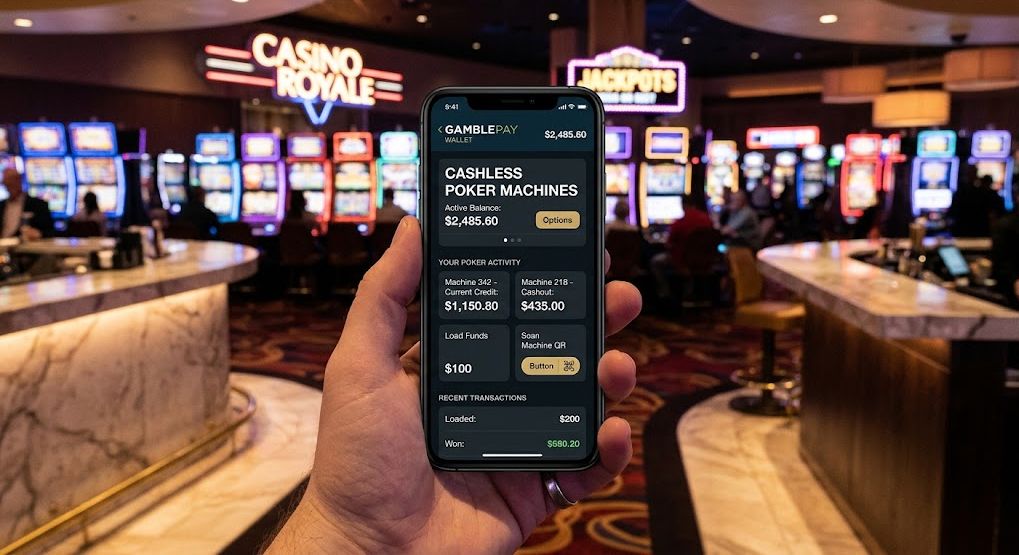
Cashless pokies have been tested in NSW pubs and clubs, and some participating venues have retained digital gaming wallet technology. For players, these systems can replace inserting banknotes with transfers from a verified account through an app or cashless player card.
However, digital wallets are not compulsory at every NSW pub. The state’s expanded cashless gaming trial ended on 30 September 2024, and participation during and after the trial was voluntary.
As of November 2026, NSW’s announced reform program includes infrastructure changes to enable account-based play. That is not the same as a confirmed deadline requiring every pub patron to use a smartphone wallet.
The key distinction is account-based gaming: connecting play to an identifiable account, rather than simply changing how money reaches a machine.
This guide explains how the technology works, what the trials tested and what players should check before registering at their local venue.
What Are Cashless Pokies?
Cashless pokies are gaming machines that support an approved payment arrangement without requiring players to insert physical money for each transfer.
Depending on the system, a player may use a smartphone application, a cashless player card or another account-linked interface.
Money moves between a funding source, the gaming account and compatible machines.
The wallet does not turn a pub’s pokies into an online casino. Play still occurs on the venue’s physical machines.
It also does not necessarily remove cash from the venue. NSW’s expanded trial used a hybrid model in which enrolled machines could accept digital payments, cash or both.
“Cashless available” and “cash prohibited” therefore describe different arrangements.
Before using a system, establish what the venue actually offers rather than relying on a cashless-gaming sign.
Cashless, Carded and Account-Based Play: The Differences
These terms frequently appear together, but they are not interchangeable.
| Term | What it describes | What it does not automatically establish |
|---|---|---|
| Cashless payment | Moving funds without using physical cash for that transaction | That every player must register |
| Digital gaming wallet | An electronic account or interface used to manage gaming funds | That it works at every venue |
| Carded play | Using a player card to access a gaming system | That the card replaces all cash payments |
| Account-based play | Connecting gaming activity to an account | That a smartphone is compulsory |
| Pre-commitment | Setting money or time limits before or during the permitted setup process | That every limit is binding |
| Self-exclusion | Restricting access under an applicable exclusion arrangement | That every venue or gambling service is covered |
A card can provide access to an account without functioning like a bank card.
Likewise, a wallet can support limits without making those limits mandatory for everyone.
The system’s rules matter more than its name.
What Happened in the NSW Cashless Gaming Trial?
NSW’s expanded Cashless Gaming Trial ran from March to September 2024 under the oversight of the Independent Panel on Gaming Reform.
Fourteen venues participated: ten clubs and four hotels across 12 local government areas.
Technology was installed on 2,388 gaming machines, exceeding the government’s commitment to trial it on at least 500 machines.
Those installation figures describe technical availability, not the number of people actively using digital wallets.
The trial examined feasibility, public acceptance, harm-minimisation features, anti-money-laundering protections and practical effects on venues and customers.
It also considered infrastructure and costs associated with a broader rollout.
Temporary legal modifications supported the trial. They were not a permanent statewide replacement of ordinary gaming rules.
What Did the Participation Figures Show?
Player uptake was much smaller than machine coverage.
NSW parliamentary material recorded 243 sign-ups. Subsequent parliamentary discussion described only 14 participants as genuine active users.
That creates an important limitation: thousands of equipped machines do not produce a strong behavioural study if very few people consistently use the technology.
The trial can help identify registration barriers, technical issues and practical implementation problems.
However, a small active sample cannot establish how every NSW player would respond to a mandatory statewide system.
Two sweeping conclusions should therefore be avoided:
-
That the trial proved digital wallets would eliminate gambling harm.
-
That it proved every possible account-based model would fail.
The design, participation rules and strength of safeguards all affect what the evidence can support.
Earlier Trials Tested Different Systems
The expanded trial was not NSW’s only experience with digital wallets.
Separate regulatory sandbox trials took place at Wests New Lambton in Newcastle and Club York in Sydney.
At Wests, the Aristocrat trial ran from October 2022 to June 2023. Technology initially covered 36 machines before expanding to 144.
Players verified their identity, transferred funds from an external bank account and used a smartphone app with Bluetooth connectivity.
The IGT trial at Club York ran from April to October 2023 across 112 machines. It used an app linked to an existing bank-account debit card.
Both included features such as spending information, limits and access to breaks or self-exclusion.
These were separate projects, not one uninterrupted statewide rollout.
Can NSW Venues Still Use the Technology?
Yes. NSW Government guidance allows participating venues to retain digital gaming wallet technology after the expanded trial, subject to conditions.
Those conditions include ongoing monitoring, data collection and oversight by Liquor & Gaming NSW.
Continued use is supported by a separate ministerial order.
The arrangements do not mean every former trial venue necessarily still offers the same product, or that every machine remains connected.
A player should confirm current availability directly with the venue.
Ask whether the wallet is operating, which machines support it and whether registration is currently available.
An old trial announcement is not sufficient confirmation that a system remains usable today.
Are Cashless Pokies Becoming Mandatory in NSW?
There is no current basis for telling players that every NSW pub already requires a digital gaming wallet.
The September 2026 Gaming Reform Package includes transitioning to a two-way communication protocol to enable account-based play.
The government has also said implementation will be staged, with some reforms requiring legislative change.
Enabling account-based technology is different from imposing a universal cashless-payment requirement on a specified date.
NSW’s planned statewide exclusion register and mandatory facial recognition are also separate reforms. Their implementation should not be presented as an automatic cashless-wallet deadline.
Older policy announcements can remain visible online. Check their date and whether later announcements changed the position before treating them as current instructions.
How to Start Using a Digital Gaming Wallet
There is no single NSW app that can be assumed to work at every pub.
The following is a general process, not a product-specific tutorial.
1. Confirm Compatibility
Ask staff which system the venue supports and whether your chosen machine is connected.
Use the venue’s verified registration instructions. Do not install an app simply because its name resembles the venue’s product.
2. Register and Verify Your Identity
Complete the required account checks through the approved process.
The expanded trial required customer due diligence and mechanisms limiting players to one account per cashless product.
3. Review the Conditions
Check limits, funding options, withdrawal procedures, privacy information and support arrangements.
4. Fund and Connect the Account
Use the supported funding source and follow the venue’s instructions for connecting to a compatible machine.
Never assume the process is identical across suppliers.
Why Identity Verification Is Required
Identity checks distinguish an account-based gaming system from an anonymous stored-value arrangement.
The NSW trial requirements included know-your-customer procedures, verified funding sources and traceable movement of funds.
They also required mechanisms to prevent minors from using the technology and to connect with relevant exclusion systems.
Verification may require personal details and accepted evidence of identity. The exact process depends on the product.
Do not create an account for another person or let someone use yours.
Account sharing can undermine exclusion controls, transaction records and the ability to resolve a dispute.
Ask who conducts verification and how documents are handled before providing sensitive information.
Do You Need a Smartphone?
Not necessarily.
The expanded NSW trial’s technical requirements allowed a digital payment platform, a cashless player card or approved combinations.
However, that does not guarantee every participating venue offers a physical-card alternative.
Some systems depend on an app. Others may support different interfaces.
Ask staff about:
-
Card-based access.
-
Supported phones and operating systems.
-
Accessibility assistance.
-
Lost-card replacement.
-
What happens if a phone battery dies.
-
How funds are retrieved without the original device.
A future account-based requirement would not, by definition, mean everyone must own a particular smartphone.
The final technical rules would determine the available access methods.
How Deposits and Machine Transfers Work
A wallet balance and a machine balance may be separate.
Depositing money into an account does not necessarily place the full amount on a gaming machine.
NSW’s trial requirements sought active choices when transferring money. They prohibited automatic top-ups, default transfers of the entire wallet and preset or suggested transfer amounts.
They also specified a maximum gaming balance of A$5,000 and a A$500 top-up limit within the trial framework.
Cash top-ups through the trial technology were limited to A$1,000 per day. The government explicitly stated that this restriction did not apply to other payment methods.
These are trial-design conditions, not universal limits governing every NSW gaming transaction.
Ask how the current product applies them.
Can You Fund a Wallet With a Credit Card?
The expanded NSW trial requirements prohibited using credit, including credit cards, to fund the technology.
They instead required verified sources such as an Australian bank account or linked debit card.
That distinction matters because a debit card accesses available account funds, while credit involves borrowing.
A familiar payment logo does not establish that all card types are accepted.
Before depositing, confirm the supported method and account-ownership requirements.
Also check whether the provider applies fees or processing delays. Do not assume all transfers are free or immediate because the interface is digital.
Borrowing to gamble increases financial risk regardless of the payment technology used.
What Spending and Time Limits Were Included?
The trial required customisable gambling-spend and time-limit options.
Players had to actively provide or opt out of an individual daily deposit limit before their first deposit.
Set limits could be reduced immediately. Increasing them required a delay of at least 24 hours.
Gaming through the technology was to be disabled when applicable limits were exceeded.
The distinction between deposit and loss limits is important.
A deposit limit restricts money entering the account. It does not necessarily measure net losses.
Likewise, a time limit and a spending limit address different behaviour.
Before relying on a limit, ask what it measures, where it applies and what happens when it is reached.
Why Hybrid Systems Have Limitations
A digital restriction is strongest when its scope is clear.
During a hybrid trial, cash and digital payments could coexist. An account-based control therefore did not automatically restrict every other way of playing.
A wallet limit should not be described as a venue-wide or statewide barrier unless the system actually enforces that scope.
This is one reason voluntary-wallet findings cannot simply be applied to a fully mandatory account-based model.
For players seeking stronger protection, ask how wallet restrictions connect with self-exclusion.
Do not rely solely on a payment setting if you need help preventing further gambling.
The availability of a limit is useful, but its coverage determines its practical value.
How Do Withdrawals and Winnings Work?
Before depositing, establish how to retrieve both unused money and gaming proceeds.
Ask whether funds must first move from the machine back to the wallet, whether withdrawal goes to a nominated bank account and how long that transfer takes.
The trial requirements included a A$5,000 limit on payouts credited directly to the wallet.
Prize amounts above A$5,000 were to be quarantined for at least 24 hours or transferred to the player’s bank account.
For prizes above A$500 and up to A$5,000, the design required an active choice about withdrawing, quarantining or continuing to play.
These requirements did not remove other applicable NSW gaming laws.
A digital interface does not guarantee instant access to every payout.
Does a Digital Wallet Change the Odds?
Changing the funding method does not, by itself, improve the machine’s odds or return to player.
A wallet manages access to funds and account information. It is not a strategy for winning.
The more relevant question is how payment design affects awareness and behaviour.
An account history can make expenditure easier to review. Conversely, frictionless transfers may make it easier to keep adding money unless effective controls intervene.
That is why the trial required active transfer choices, accessible play information and delays around accessing additional funds.
Convenience should be assessed alongside safeguards.
A faster payment process is not automatically a better gambling outcome.
Privacy, Transaction Records and Marketing
Account-based systems can connect personal identity with funding and gaming activity.
Players should understand who operates the wallet, who holds the funds and which organisations receive information.
The NSW trial required privacy compliance, security controls and incident-response plans.
It also required tracked information to be available to the regulator and law enforcement on request.
The requirements prohibited unlawful access or sharing and using player data for targeted marketing or other strategies intended to increase gambling.
That is different from promising complete anonymity.
Read the privacy notice and ask about retention, correction rights, external providers and complaint handling.
A venue should be able to explain these arrangements without referring every basic question to a supplier.
What Happens if the App Stops Working?
An outage should trigger troubleshooting, not another deposit.
First establish whether the issue concerns login access, the machine connection, a pending transfer or withdrawal processing.
Keep transaction identifiers and note the time, amount and machine involved.
Ask staff to confirm where the funds currently sit.
Avoid repeatedly submitting the same transfer while its status is unclear.
The trial required incident-management plans covering cyberattacks, major outages and significant disruptions.
Players should nevertheless ask what practical assistance is available outside normal support hours.
Never provide a password or authentication code to someone claiming they need it to release funds.
What Eastern-State Players Should Understand
There is no single cashless-pokies rollout covering all eastern states.
Victoria has its own YourPlay framework and carded-play reforms. Its casino requirements should not be assumed to apply identically to pubs and clubs.
Victorian parliamentary discussion of the hotel and club trial distinguished mandatory card use from optional limits during the initial phase.
That illustrates why “mandatory carded play” does not necessarily mean every possible safeguard is compulsory.
Similarly, a NSW wallet should not be assumed compatible with a Victorian system or another state’s venue.
Check the jurisdiction, venue and product separately.
A shared direction towards account-linked technology does not create one national account, card or implementation date.
Review Verdict: Useful Tools, but Not a Finished Statewide System
Digital gaming wallets can provide clearer transaction records, accessible spending information and account-linked restrictions.
Their usefulness depends on reliable operation, straightforward withdrawals, meaningful privacy controls and safeguards that cover the relevant activity.
NSW’s trials demonstrated real-world implementation, but limited active participation restricts broad conclusions about player outcomes.
The immediate practical position is simple: some venues can retain the technology, participation has been voluntary, and NSW is developing infrastructure to enable account-based play.
Before registering, ask how the system works at your particular pub—not how a future statewide product might work.
If gambling is becoming difficult to control, seek support rather than relying on an app alone. NSW GambleAware assistance is available on 1800 858 858.
Frequently Asked Questions
Are cashless pokies mandatory in NSW pubs?
No. Digital gaming wallets are not compulsory at every NSW pub. The expanded NSW cashless gaming trial ended in September 2024, and participating venues can retain the technology under specified conditions. Infrastructure changes to enable account-based play do not, by themselves, establish a universal cashless-payment deadline.
How do you use a digital gaming wallet at a pub?
Check which system the venue supports, follow its verified registration instructions and complete the required identity checks. You can then use an accepted funding source and connect your account to a compatible machine. Registration, transfers and withdrawals vary between products.
Do you need a smartphone to play cashless pokies?
Not necessarily. Some systems use smartphone apps, while others may support a cashless player card. A card-based option is not guaranteed at every venue. Ask staff about available access methods, device compatibility and how to retrieve funds if your phone or card becomes unavailable.
Can you set spending limits with a digital gaming wallet?
Digital wallets can offer deposit, spending or time limits, depending on the system. Check what each limit measures, whether it is binding and where it applies. A wallet limit should not be assumed to restrict cash play, other accounts or gambling at different venues.
How do you withdraw money from a digital gaming wallet?
The process depends on the provider. You may need to transfer remaining machine credits back to your wallet before requesting payment to a nominated bank account. Before depositing, check withdrawal times, fees, verification requirements and any separate rules for larger gaming payouts.
Sources
- NSW Government: Cashless Gaming Trial dates, voluntary participation and legal arrangements
- NSW Parliament: Participating venues, local government areas and machine numbers
- NSW Parliament: Trial participation figures and discussion of evidence limitations
- Liquor & Gaming NSW: Wests New Lambton and Club York digital wallet trials
- NSW Government: Identity checks, funding controls, limits, privacy and trial payout requirements
- NSW Government: Continued use of digital wallets after the trial
- NSW Government: September 2026 reform package and infrastructure to enable account-based play
- Victorian Government: YourPlay in hotels and clubs
- Victorian Parliament: Carded-play trial design and distinction between card use and optional limits